

Beyond the Code: Morgan Stanley's Human-First Approach to AI Governance (Ft. Jeff McMillan on The RegulatingAI Podcast)

RegulatingAI Podcast
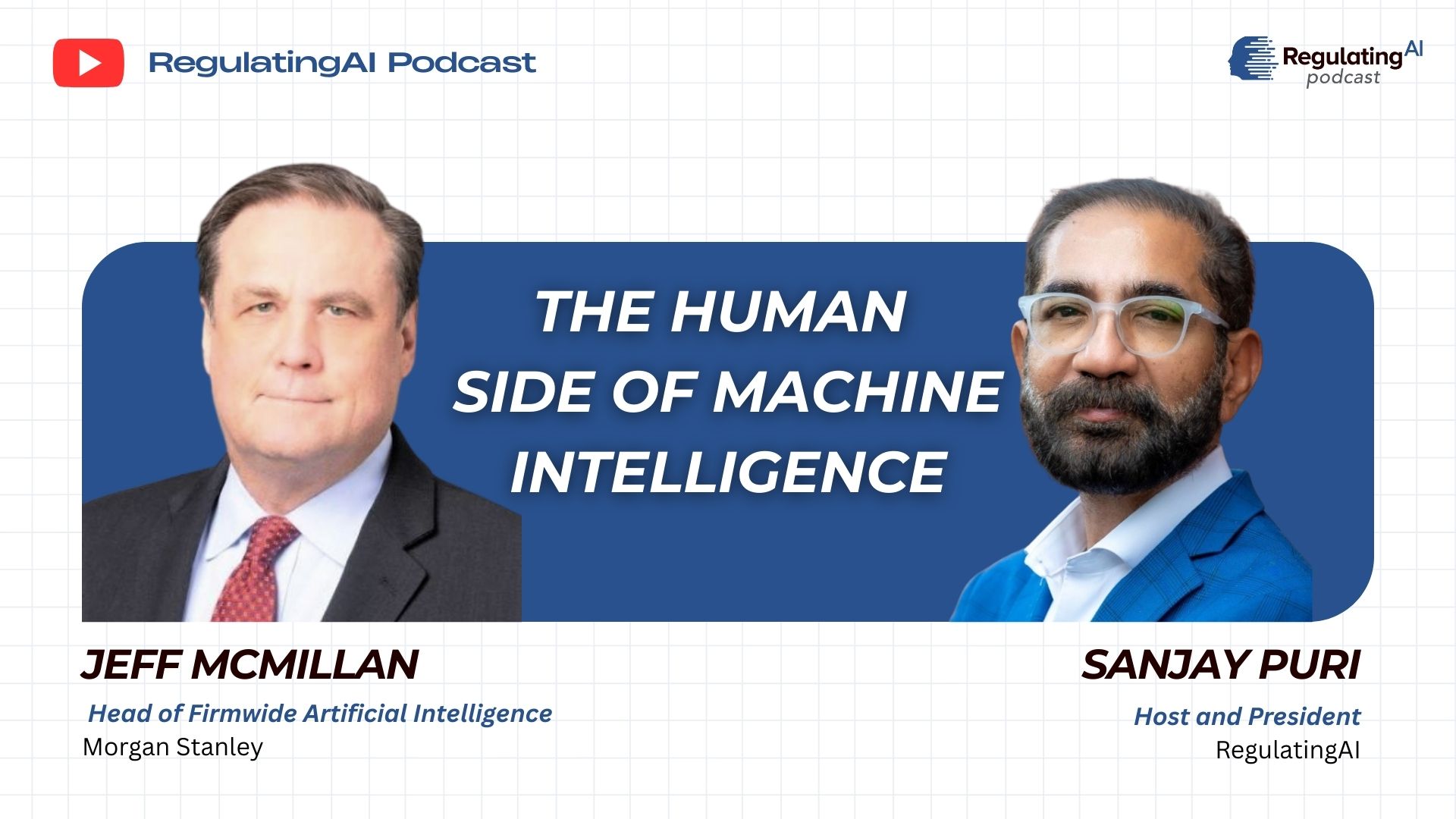
Jeff McMillan with Sanjay Puri, President of Knowledge Networks
Morgan Stanley's AI success relies on organizational focus, human accountability, and strong governance, not just tech. Moving slowly is risky.
Generative AI is incredibly easy to build and very, very difficult to deploy with high degrees of efficacy...”
WASHINGTON, DC, UNITED STATES, December 11, 2025 /EINPresswire.com/ -- The hum of AI is getting louder, promising transformations across every industry. But amidst the excitement, a crucial question often gets overlooked: how do you actually implement AI successfully, especially in complex, regulated environments like financial services? It turns out the answer isn't just about sophisticated algorithms or cutting-edge tech. It's about people, strategy, and governance.— Jeff McMillan
We recently had the pleasure of diving into this very topic, thanks to an illuminating conversation on The RegulatingAI Podcast between host Sanjay Puri and Jeff McMillan, Head of Firmwide AI at Morgan Stanley. McMillan's insights are a breath of fresh air, challenging the tech-first mindset and laying out a compelling blueprint for responsible AI innovation.
The Real AI Challenge: It's Not Technical, It's Organizational
Forget the dazzling tech demos for a moment. McMillan makes a bold assertion: the biggest hurdles to AI adoption aren't found in the code, but within the organization itself. "The reason people are failing is not because of their understanding of the underlying technology," he states. "They're failing for the same reasons they've been failing since the beginning of digital transformation: a lack of organizational focus, a lack of leadership, a lack of engagement, clarity of strategy..." It's a powerful reminder that without clear leadership, strategic alignment, and a solid connection between technology and business objectives, even the most advanced AI tools will flounder.
Morgan Stanley's Blueprint for Responsible AI Governance
Morgan Stanley wasn't just observing the AI revolution; they were helping to lead it, partnering with OpenAI as early as March 2022, well before ChatGPT became a household name. This head start allowed them to craft their own "rules of the road" in the absence of established regulations. Their governance strategy rests on four pillars:
1. Senior Supervision: Ensuring full transparency and oversight from the highest levels.
2. Human in the Loop: Acknowledging AI's helpfulness but firmly placing ultimate responsibility and accountability with the human. As McMillan aptly puts it, "the humans press the button."
3. Robust Evaluation: Recognizing that while Generative AI is easy to build, its non-deterministic nature makes high-efficacy deployment challenging. This demands rigorous, both automated and manual, input/output testing frameworks.
4. Second-Line Oversight: Establishing an independent group to validate every system before it goes live, adding a crucial layer of control.
Balancing Innovation and Risk in the AI Era
One might assume a regulated entity would move cautiously, but McMillan argues there's a "risk of moving too slow." AI isn't just a productivity tool; it can improve a firm's risk posture by enhancing monitoring and reducing output deviation. Furthermore, to mitigate bias, Morgan Stanley feeds its own curated knowledge into LLMs and rigorously tests models against demographic populations to ensure fairness.
The Indispensable Role of Education
Perhaps the most critical takeaway for any organization embarking on an AI journey is the paramount importance of employee education. Investing in training on what AI is, how to craft effective prompts, and guidelines for responsible use isn't a luxury; it's a necessity. It empowers the workforce, fosters responsible adoption, and builds an AI-literate culture from the ground up.
Leadership Lessons from West Point: Guiding AI Initiatives
Drawing on his background at West Point and in the US Army, McMillan shares three invaluable leadership lessons: Be structured yet flexible, empower your teams rather than centralizing power, and always maintain perspective.
Conclusion
Jeff McMillan's insights paint a clear picture: successful enterprise AI isn't about magical algorithms, but about thoughtful strategy, robust governance, a deep commitment to human oversight, and continuous education. As Sanjay Puri wisely concluded on the podcast, "Responsible AI isn't a constraint on innovation; it's the foundation for... sustainable and trustworthy innovation." It's a lesson every organization venturing into the AI frontier would do well to heed.
Upasana Das
Knowledge Networks
email us here
Visit us on social media:
LinkedIn
Instagram
Facebook
YouTube
X
Legal Disclaimer:
EIN Presswire provides this news content "as is" without warranty of any kind. We do not accept any responsibility or liability for the accuracy, content, images, videos, licenses, completeness, legality, or reliability of the information contained in this article. If you have any complaints or copyright issues related to this article, kindly contact the author above.
