

Economic Bulletin Issue 8, 2025
Overview
At its meeting on 18 December 2025, the Governing Council decided to keep the three key ECB interest rates unchanged. Its updated assessment reconfirmed that inflation should stabilise at the 2% target in the medium term.
According to the December 2025 Eurosystem staff macroeconomic projections for the euro area, headline inflation is expected to average 2.1% in 2025, 1.9% in 2026, 1.8% in 2027 and 2.0% in 2028. For inflation excluding energy and food, staff project an average of 2.4% in 2025, 2.2% in 2026, 1.9% in 2027 and 2.0% in 2028. Inflation has been revised up for 2026, mainly because services inflation is now expected to decline more slowly. Economic growth is expected to be stronger than in the September 2025 ECB staff macroeconomic projections for the euro area, driven especially by domestic demand. Growth has been revised up to 1.4% in 2025, 1.2% in 2026 and 1.4% in 2027 and is expected to remain at 1.4% in 2028.
The Governing Council is determined to ensure that inflation stabilises at its 2% target in the medium term. It will follow a data-dependent and meeting-by-meeting approach to determining the appropriate monetary policy stance. In particular, the Governing Council’s interest rate decisions will be based on its assessment of the inflation outlook and the risks surrounding it, in light of the incoming economic and financial data, as well as the dynamics of underlying inflation and the strength of monetary policy transmission. The Governing Council is not pre-committing to a particular rate path.
Economic activity
The economy has been resilient. It grew by 0.3% in the third quarter of 2025, mainly reflecting stronger consumption and investment. Exports also increased, with a significant contribution from chemicals. The sectoral composition of growth was dominated by services, especially in the information and communication sector, while activity in industry and construction remained flat. This pattern of services-led growth is likely to continue in the near term.
The economy is benefiting from a robust labour market. Unemployment, at 6.4% in October 2025, is close to its historical low, and employment grew by 0.2% in the third quarter. At the same time, labour demand cooled further, with the job vacancy rate at its lowest level since the COVID-19 pandemic.
Domestic demand is expected to remain the main driver of euro area growth, bolstered by rising real wages and employment, in the context of resilient labour markets with record low unemployment rates. Additional government spending on infrastructure and defence announced in 2025, especially in Germany, alongside improved financing conditions stemming from monetary policy rate cuts since June 2024, is also expected to support the domestic economy. On the external side, while competitiveness challenges persist, including some that are of a structural nature, exports are expected to pick up in 2026. This improvement is attributed to a rebound in foreign demand amid declining trade policy uncertainty, despite a gradually unfolding impact from higher tariffs. Annual average real GDP growth is projected to be 1.4% in 2025, 1.2% in 2026, 1.4% in 2027 and 1.4% in 2028. Compared with the September 2025 projections, GDP growth has been revised up over the whole projection horizon, reflecting better than expected data, reduced trade policy uncertainty, stronger foreign demand and lower energy commodity prices.
The Governing Council stresses the urgent need to strengthen the euro area and its economy in the present geopolitical context. It welcomes the European Commission’s call for governments to prioritise sustainable public finances, strategic investment and growth-enhancing structural reforms. Unlocking the full potential of the Single Market is crucial. It is also vital to foster further capital market integration by completing the savings and investments union and the banking union to an ambitious timetable, and to rapidly adopt the Regulation on the establishment of the digital euro.
Inflation
Euro area annual inflation, as measured by the Harmonised Index of Consumer Prices (HICP), has been in a narrow range since spring 2025 and remained at 2.1% in November. Energy prices were 0.5% lower than in the previous November, after a larger decline in October 2025. Food price inflation was 2.4%, after 2.5% in October and 3.0% in September. Inflation excluding energy and food was steady at 2.4%, as goods and services inflation moved in opposite directions. Goods inflation declined to 0.5% in November, from 0.6% in October and 0.8% in September. Services inflation rose to 3.4% in October and 3.5% in November, from 3.2% in September.
Indicators of underlying inflation have changed little over recent months and remain consistent with the Governing Council’s 2% medium-term target. While growth in unit profits was unchanged in the third quarter of 2025, unit labour costs grew at a slightly higher rate than in the second quarter. Compensation per employee rose at an annual rate of 4.0%. This was more than expected in the September 2025 staff projections and was due to payments over and above negotiated wages. Forward-looking indicators, such as the ECB’s wage tracker and the results of surveys on wage expectations, suggest that wage growth will ease in the coming quarters, before stabilising somewhat below 3% towards the end of 2026.
Most measures of longer-term inflation expectations continue to stand at around 2%, supporting the stabilisation of inflation around the Governing Council’s target. Inflation is projected to decrease from 2.1% in 2025 to 1.9% in 2026 and then to 1.8% in 2027, before rising to the Governing Council’s medium-term target of 2% in 2028. The expected decline in headline inflation at the start of 2026 reflects a downward base effect stemming from energy prices, while inflation in non-energy components should continue to ease throughout 2026. The contribution of energy inflation to headline inflation is expected to remain muted up to late 2027, before increasing notably in 2028 driven by the expected implementation of the EU Emissions Trading System 2 (ETS2), with an upward impact of 0.2 percentage points on headline inflation. HICP inflation excluding energy is expected to fall from 2.5% in 2025 to 2.2% in 2026 and to 2.0% in 2027 and 2028. Food inflation is projected to drop noticeably as the effects of prior price increases in global food commodities and adverse weather conditions over the summer subside, and is expected to stabilise at rates somewhat above 2% as of late 2026. HICP inflation excluding energy and food is projected to moderate from 2.4% in 2025 to 2.0% in 2028 as services inflation declines amid easing labour cost pressures, and as the past appreciation of the euro feeds through the pricing chain, curbing goods inflation. Wage growth should continue to moderate through 2026, before stabilising at around 3%, underpinned by a resilient labour market and productivity growth just slightly below 1%. Unit labour cost growth is expected to ease, although the impact on inflation is expected to be partly offset by a gradual recovery in profit margins over the projection horizon.
Compared with the September 2025 projections, the outlook for headline HICP inflation has been revised up by 0.2 percentage points for 2026, reflecting recent data surprises for HICP inflation and wage growth, with the latter leading to a notable upward revision to the wage outlook. The projection for HICP inflation has been revised down slightly for 2027. This is the result of an assumed lower contribution from energy inflation, since the implementation of ETS2 is now expected to be postponed from 2027 to 2028. However, this contribution is expected to be partly offset by stronger services inflation.
Risk assessment
While trade tensions have eased, the still volatile international environment could disrupt supply chains, dampen exports, and weigh on consumption and investment. A deterioration in global financial market sentiment could lead to tighter financing conditions, greater risk aversion and weaker growth. Geopolitical tensions, in particular Russia’s unjustified war against Ukraine, remain a major source of uncertainty. By contrast, planned defence and infrastructure spending, together with productivity-enhancing reforms, may drive up growth by more than expected. An improvement in confidence could stimulate private spending.
The outlook for inflation continues to be more uncertain than usual on account of the still volatile international environment. Inflation could turn out to be lower if the rise in US tariffs reduces demand for euro area exports and if countries with overcapacity increase their exports to the euro area. Moreover, a stronger euro could bring inflation down further than expected. An increase in volatility and risk aversion in financial markets could weigh on demand and thereby also lower inflation. By contrast, inflation could turn out to be higher if more fragmented global supply chains pushed up import prices, curtailed the supply of critical raw materials and added to capacity constraints in the euro area economy. A slower reduction in wage pressures could delay the decline in services inflation. A boost in defence and infrastructure spending could also raise inflation over the medium term. Extreme weather events, and the unfolding climate and nature crises more broadly, could drive up food prices by more than expected.
Financial and monetary conditions
Market rates have increased since the Governing Council’s last monetary policy meeting on 30 October 2025. Bank lending rates for firms have been broadly stable since the summer, after falling in response to its policy rate cuts over the previous year. In October they stood at 3.5%, unchanged from September. The cost of issuing market-based debt was 3.4%, also close to its September level. The average interest rate on new mortgages again held steady, at 3.3% in October.
Bank lending to firms grew by 2.9% on a yearly basis in October, unchanged from September. Corporate bond issuance rose by 3.2%, broadly unchanged as well. Mortgage lending strengthened, growing by 2.8% after 2.6% in September.
In line with the ECB’s monetary policy strategy, the Governing Council thoroughly assessed the links between monetary policy and financial stability. Euro area banks are resilient, supported by strong capital and liquidity ratios, solid asset quality and robust profitability. However, geopolitical uncertainty and the possibility of a sudden repricing in global financial markets pose risks to financial stability in the euro area. Macroprudential policy remains the first line of defence against the build-up of financial vulnerabilities, enhancing resilience and preserving macroprudential space.
Monetary policy decisions
The interest rates on the deposit facility, the main refinancing operations and the marginal lending facility were unchanged at 2.00%, 2.15% and 2.40% respectively.
The asset purchase programme and pandemic emergency purchase programme portfolios are declining at a measured and predictable pace, as the Eurosystem no longer reinvests the principal payments from maturing securities.
Conclusion
At its meeting on 18 December 2025, the Governing Council decided to keep the three key ECB interest rates unchanged. It is determined to ensure that inflation stabilises at its 2% target in the medium term. It will follow a data-dependent and meeting-by-meeting approach to determining the appropriate monetary policy stance. The Governing Council’s interest rate decisions will be based on its assessment of the inflation outlook and the risks surrounding it, in light of the incoming economic and financial data, as well as the dynamics of underlying inflation and the strength of monetary policy transmission. The Governing Council is not pre-committing to a particular rate path.
In any case, the Governing Council stands ready to adjust all of its instruments within its mandate to ensure that inflation stabilises sustainably at its medium-term target and to preserve the smooth functioning of monetary policy transmission.
1 External environment
The global economy has shown resilience thus far despite the headwinds caused by tariffs and heightened uncertainty. This resilience is notably supported by investments related to artificial intelligence, particularly in the United States. These investments bolster global trade in technology products and drive gains in equity markets, although also raising concerns about valuations. A supportive policy mix across major economies has also mitigated some of the negative impact of trade tensions and uncertainty. Other positive developments are providing relief to the global economy. These include lower oil prices, easier financial conditions, lower tariffs and slightly reduced policy uncertainty. As a result, the global growth outlook in the December 2025 Eurosystem staff macroeconomic projections has been revised up slightly compared with the previous projections, although it remains subdued relative to its pre-pandemic average. Headline consumer price inflation across major advanced and emerging market economies is projected to decline gradually and at a somewhat faster pace compared with the previous projection exercise.
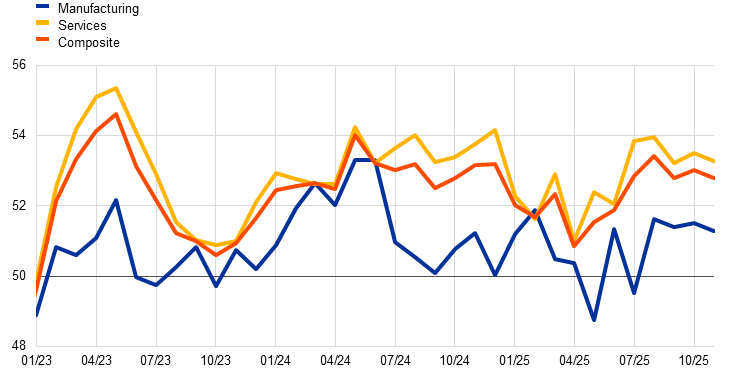
The global economy has shown resilience thus far despite the headwinds caused by tariffs and heightened uncertainty. Incoming data for the third quarter suggest a slight moderation in global economic activity compared with the second quarter of 2025. The global (excluding the euro area) composite output Purchasing Managers’ Index (PMI) dropped slightly since the summer months to 52.8 in November (Chart 1). According to this survey indicator, economic activity in November slowed across most major economies. In the United States, the decline in services activity was partly offset by an improvement in manufacturing, while China recorded declines in both sectors. National data releases for the third quarter broadly confirm the expected moderation in growth, as embedded in the December 2025 Eurosystem staff macroeconomic projections.
Chart 1
Global output PMI (excluding the euro area)
(diffusion indices)
Sources: S&P Global Market Intelligence and ECB staff calculations.
Note: The 50-index point line refers to the neutral threshold. The latest observations are for November 2025.
Looking ahead, several positive developments are expected to provide relief to the global economy. These include lower oil prices, easier financial conditions, reduced tariffs especially between the United States and China, and slightly reduced policy uncertainty. Positive economic data surprises from major economies have also contributed to a slightly improved global growth outlook, which nevertheless remains subdued relative to its pre-pandemic average. It is estimated to stand at 3.5% in 2025 before drifting lower to 3.3% in 2026.[1] The staff projections foresee that global growth will maintain this subdued momentum in both 2027 and 2028.
Slightly stronger global growth compared with the previous projections largely reflects a stronger growth outlook for both the United States and China. In addition to lower tariffs, the growth outlook for the United States has been revised upwards slightly due to more resilient domestic demand than previously expected, supported over the near term by positive wealth effects stemming from recent equity price developments and by overall higher fiscal spending assumptions. For China, real GDP growth projections for this year and next have also been slightly revised upwards to reflect stronger export dynamics than previously estimated and a larger assumed fiscal stimulus. The growth outlook for the United Kingdom has been revised downwards slightly owing to the foreseen fiscal consolidation measures.
Risks to the global growth outlook and the global inflation outlook are becoming more balanced as the key macroeconomic and financial risk factors become more two-sided. These include risks related to trade and fiscal policies, as well as risks related to artificial intelligence (AI) and geopolitical developments. For example, while trade tensions could escalate again, especially between the United States and China, which could have adverse effects on the global economy, the Trump Administration may also make progress on trade negotiations, which could have beneficial effects.
Global import growth is estimated to remain steady in 2025, although its momentum is expected to slow next year. Incoming data confirm that semiconductor exports linked to strong AI-related investment remained robust in the third quarter, especially in relation to developments in the United States. At the same time, trade in other goods turned out to be rather weak. Incoming data also confirm that Chinese export growth remains strong. Global import growth is projected to be 4.4% in 2025, largely reflecting strong import growth in the first half of the year related to frontloaded demand ahead of tariffs, before declining to 2.0% in 2026 due to the adverse impact of tariffs. Global import growth is then projected to recover to 3.1% in both 2027 and 2028. The outlook for global imports has been revised upwards significantly for this year and next compared with the previous projections, while the projection for 2027 remains unchanged. The stronger projected import growth is underpinned by lower tariffs agreed between the United States and China, as well as relatively strong growth momentum across emerging market economies. Among the latter group, India stands out in terms of its robust economic activity and import growth.
Headline inflation across members of the Organisation for Economic Co-operation and Development (OECD) increased slightly in November. The annual rate of consumer price index (CPI) inflation across OECD member countries, excluding Türkiye, increased slightly to 3.0% in November from 2.9% in October. This increase was driven by a slightly higher contribution from the food and core components (Chart 2).
Chart 2
OECD CPI inflation
(year-on-year percentage changes, percentage point contributions)

Sources: OECD and ECB staff calculations.
Notes: The OECD aggregate includes euro area countries that are OECD members and excludes Türkiye. It is calculated using OECD CPI annual weights. The latest observations are for November 2025.
Global headline CPI inflation is projected to decline gradually and at a somewhat faster pace compared with the September projections.[2] It is expected to stand at 3.1% in 2025, 2.8% in 2026, 2.5% in 2027 and 2.6% in 2028. The slightly faster than previously projected decline in CPI inflation over the 2025-26 period reflects lower than expected inflation outcomes across most advanced economies, lower US-China tariffs, and the reassessment of the impact of tariffs on inflation in the United States, which is expected to be slightly lower compared with the previous projections. Furthermore, weaker domestic demand in China explains a more gradual than previously expected increase in consumer price inflation over the projection horizon. This effect on the emerging market aggregate is compensated by slightly higher projected inflation in other major economies, such as India and Russia.
Perceptions of increased prospects for a peace agreement in Ukraine weighed on energy commodity prices. Oil prices had initially been supported in the run-up to the October Governing Council meeting by the announcement of new US sanctions on Russia’s two major oil-producing companies, Lukoil and Rosneft, which account for the major share of Russian exports. More recently, however, renewed US efforts to advance peace negotiations in Ukraine have lowered the perceived likelihood of strict enforcement of these sanctions, placing downward pressure on prices. This downward pressure has been amplified by a supply surplus that has been building in the oil market for several months. Regarding gas prices, although a recent cold spell in western Europe temporarily lifted consumption and weighed on inventories, prices ultimately fell by 15% due to perceptions of some progress towards a potential Ukraine peace deal. Given Europe’s continued efforts to end its reliance on Russian fossil fuels, this downward pressure is unlikely to stem from expectations of renewed Russian pipeline flows. Instead, it more likely reflects the possibility that a peace deal could lead to the removal of US sanctions affecting parts of Russia’s liquefied natural gas export capacity. Metal prices rose by 2%, supported by renewed expectations of US tariffs on copper, which prompted traders to accelerate shipments to the United States. By contrast, food prices fell by 3% amid signs of a strong cocoa supply.
Economic activity in the United States has been adversely affected by the federal government shutdown. The shutdown lasted 43 days and delayed key data releases. It is expected to negatively affect growth also in the fourth quarter of 2025, whereas a large part of this effect is projected to be recouped in the first quarter of 2026. Private consumption exceeded expectations this year, supported by wealth gains among higher-income households amid booming equity markets. However, it is expected to slow as the labour market cools and households rebuild savings from low levels. In the third quarter, private consumption growth was strong, though it stalled in September on a monthly basis. Private sector proxies for private consumption signal weak growth in October and November, in line with declining consumer sentiment and a soft labour market. The boom in AI-related capital expenditures underpins a stronger private investment outlook. Net trade is expected to contribute positively to real GDP growth at the turn of the year. The labour market remains soft despite private sector job growth exceeding expectations in September, as the impact of this positive surprise was tempered by downward revisions to private employment in the previous months. Private sector data indicate very muted employment growth in October and November, while high-frequency indicators suggest increased lay-offs and stagnant employment growth. Hourly wage growth continues to moderate.
Meanwhile, tariffs are having an impact on consumer price inflation in the United States. Tariffs on consumer goods contributed to inflationary pressures, with momentum in goods inflation reaching its highest level since April 2023. Tariff-related price increases are expected to contribute to higher inflation in the fourth quarter. Services inflation continues to slowly follow a downward trend, mainly due to slowing housing cost inflation. Meanwhile, headline personal consumption expenditures (PCE) inflation increased slightly to 2.8% in September (by 0.1 percentage points), whereas core PCE inflation declined to 2.8% (by 0.1 percentage points). The Federal Open Market Committee lowered the target range for the federal funds rate at its December meeting (by 25 basis points) to 3.50-3.75%.
China’s short-term outlook points to moderating growth momentum despite stronger than expected growth in the third quarter. Domestic demand is still weak, even though real GDP grew by 1.1% quarter-on-quarter in the third quarter, exceeding market expectations. Net exports contributed positively, while indicators of domestic demand, such as retail sales and fixed-asset investment, weakened further in relation to subdued consumer confidence and ongoing adjustment in the residential property sector. According to the PMI survey, manufacturing activity contracted in November, while services sector activity softened but remained in expansionary territory. China’s export performance has been robust, with nominal goods export growth reaching 5.8% in November in annual terms, supported by strong exports to the Association of Southeast Asian Nations (ASEAN), Africa and Europe. These increases more than compensated for the decline in US-bound exports. The recent US-China trade agreement, which reduces tariffs on Chinese imports, together with increased fiscal stimulus under China’s new five-year plan, are expected to support economic growth over the projection horizon. However, structural challenges, such as the still ongoing correction in the residential real property sector, weigh on consumer sentiment and thus pose risks to the medium-term outlook for consumption. Headline consumer prices in China increased further in November, while producer price deflation persisted. Annual headline CPI inflation rose to 0.7% in November, the highest since February last year, up from 0.2% in October. The increase was in line with market expectations and was driven mainly by food prices due to supply shortages caused by adverse weather. Producer price inflation declined slightly to -2.2% in November from -2.1% in October, reflecting lower raw material and consumer durable goods prices.
In the United Kingdom, the economy exhibited modest growth in the third quarter of 2025. Private consumption remained weak, but residential investment provided some support. Flash PMI data for November suggest continued soft economic momentum into the fourth quarter, with services activity weakening and manufacturing output showing minor improvements. Headline CPI inflation eased to 3.6% in October, down from 3.8% in September. Core inflation also eased to 3.4%, driven by services inflation, which declined to 4.5%. Wage growth slowed but remained elevated. The autumn budget announced on 26 November includes higher fiscal spending in the coming years, whereas policy measures such as an extended freeze on personal tax thresholds are expected to generate additional fiscal revenues mostly as of 2028.
2 Economic activity
The euro area economy is proving to be resilient despite the challenging global environment. Real GDP increased by 0.3% in the third quarter of 2025, which was above the September 2025 ECB staff macroeconomic projections for the euro area. This followed volatile developments in the first half of the year, reflecting the effects of frontloading in response to higher US trade tariffs and related uncertainty, as well as the impact of sharp fluctuations in Irish data. Growth in the third quarter was driven by domestic demand and inventory accumulation on the expenditure side, with market services – particularly the information and communications sector – contributing in terms of value added, while industry and construction remained flat. Survey data currently signal continued moderate growth momentum in the fourth quarter of 2025, led by services activity. The labour market remains resilient, but shows signs of slowing, with notable differences across countries and sectors. The unemployment rate held steady at 6.4% in September and October, close to recent historical low levels.
Domestic demand is expected to support GDP growth in the near to medium term. Gains in real incomes and a resilient labour market are likely to sustain private consumption, and housing investment is expected to recover in the fourth quarter and beyond, as suggested by leading indicators. Business investment is also set to expand, driven by intangibles, while tangible investments are likely to remain more subdued in the near term. Factors such as rising demand, higher profits, reduced uncertainty, additional defence and infrastructure spending, as well as improved financing conditions, are expected to bolster investment and activity growth further in the medium term.
This outlook is broadly reflected in the December 2025 Eurosystem staff macroeconomic projections for the euro area, which foresee annual average real GDP growth of 1.4% in 2025, 1.2% in 2026, 1.4% in 2027 and 1.4% in 2028. Compared with the September 2025 projections, GDP growth has been revised up over the whole projection horizon.[3]
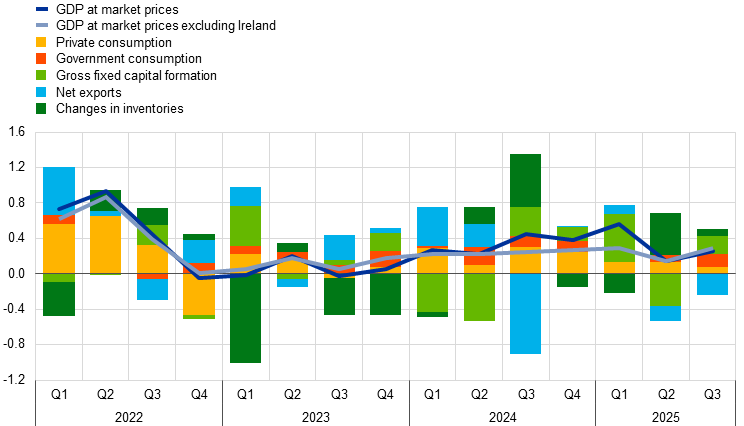
The euro area economy grew by 0.3% in the third quarter of 2025, according to the latest Eurostat estimate, after a volatile first half of the year (Chart 3). Growth in the third quarter was driven by domestic demand and inventory accumulation, while net trade contributed negatively, owing to strong import growth, particularly in Ireland. The rise in intangible investments and detailed services production data suggest that AI-related expenditure is increasing. Growth in gross value added in the third quarter was driven by market services, led by the information and communications sector, while the contributions from industry and construction were flat.
Chart 3
Euro area real GDP and its components
(quarter-on-quarter percentage changes; percentage point contributions)
Sources: Eurostat and ECB calculations.
Note: The latest observations are for the third quarter of 2025.
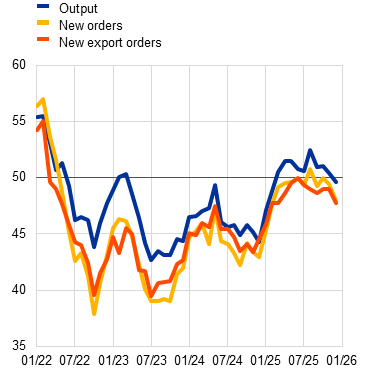
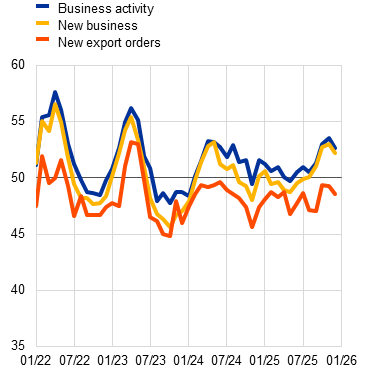
Survey data indicate moderate growth momentum in the fourth quarter of 2025, driven by services activity. In the first month of the fourth quarter, industrial production excluding construction was 0.6% higher than in the third quarter, when it declined by 0.1%. As for survey data, the euro area composite output Purchasing Managers’ Index (PMI) averaged 52.4 in the fourth quarter, up from 51.0 in the third quarter, while the monthly profile decreased from 52.8 in November to 51.9 in December. This decrease was driven by services business activity (which stood at 52.6) (Chart 4, panel b) and a fall in manufacturing output to below the no-growth threshold of 50, reaching 49.7 (Chart 4, panel a). Looking beyond the fourth quarter, forward-looking PMIs for new orders and business expectations continue to signal moderate services-led growth, while manufacturing performance appears to remain subdued in the near term.
Chart 4
PMI indicators across sectors of the economy
a) Manufacturing |
b) Services |
|---|---|
(diffusion indices) |
(diffusion indices) |
 |
 |
Source: S&P Global Market Intelligence.
Note: The latest observations are for December 2025.
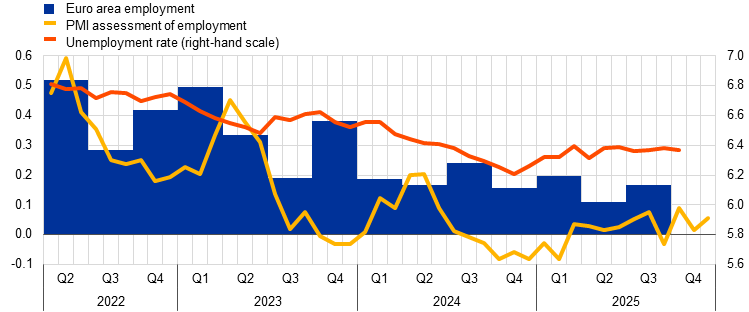
The labour market remained resilient in the third quarter of 2025, although labour demand continued to gradually soften. Employment and total hours worked increased by 0.2% and 0.4% respectively in the third quarter of 2025 (Chart 5). The ongoing moderation in employment growth partly reflects a softening in labour demand, with the job vacancy rate declining to 2.2% in the third quarter, falling below the pre-pandemic levels observed in the fourth quarter of 2019. The labour force remained stable in the third quarter, with October numbers indicating month-on-month growth of 0.1%. At the same time, the unemployment rate stood at 6.4% in October, having stayed within a range of 6.3% to 6.4% since the beginning of the year.
Chart 5
Euro area employment, PMI assessment of employment and unemployment rate
(left-hand scale: quarter-on-quarter percentage changes, diffusion index; right-hand scale: percentages of the labour force)
Sources: Eurostat, S&P Global Market Intelligence and ECB calculations.
Notes: The two lines indicate monthly developments, while the bars show quarterly data. The PMI is expressed in terms of the deviation from 50, then divided by 10 to gauge quarter-on-quarter employment growth. The latest observations are for the third quarter of 2025 for euro area employment, December 2025 for the PMI assessment of employment and October 2025 for the unemployment rate.
Short-term labour market indicators point to slightly positive employment growth in the fourth quarter. The monthly composite PMI employment index stood at 50.6 in December, with a quarterly average of 50.5, suggesting broadly flat employment growth in the fourth quarter. PMI employment in the services sector has hovered at around 51 since the beginning of the year and stood at 51.3 in December, while the PMI employment indicator for manufacturing remained in negative territory, reaching 48.5 in the December release, with a quarterly average of 48.1.
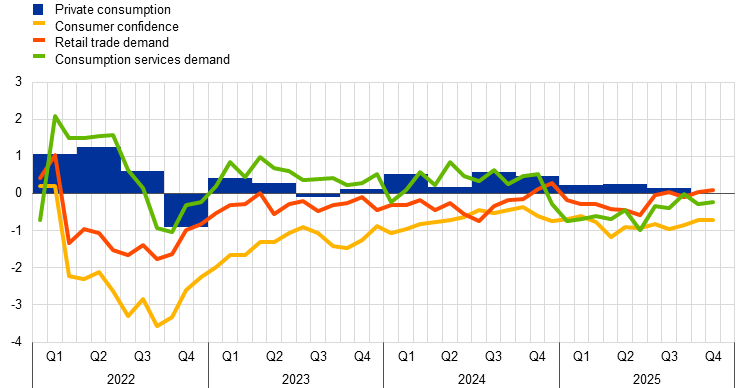
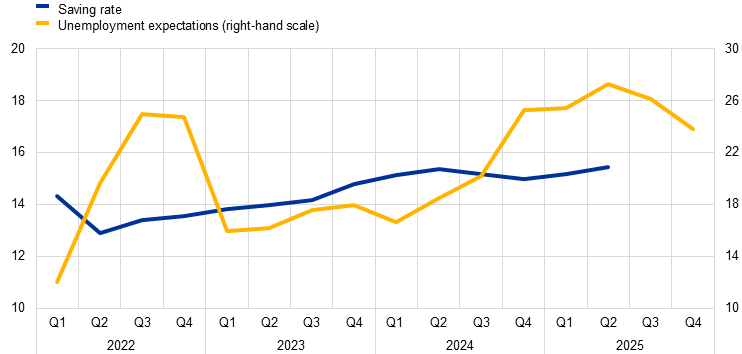
Private consumption continued to expand in the third quarter of 2025 and is expected to maintain its momentum in the fourth quarter. Private consumption expanded by 0.2%, quarter on quarter, in the third quarter of the year, broadly in line with the dynamics observed in the second quarter (Chart 6, panel a). Spending on services continued to rise, while the consumption of goods moderated. Retail trade and services production increased modestly in the third quarter relative to the second, by 0.2 % and 0.3% respectively, quarter on quarter, while retail sales remained unchanged in October, in month-on-month terms. Survey evidence suggests robust momentum in private consumption heading into the year-end, with the European Commission’s consumer confidence indicator holding steady in November. Business expectations for demand in retail trade and consumer services over the next three months improved in November, with demand for consumer services nearing pre-pandemic levels. Across contact-intensive services, the European Commission’s indicators of expected demand weakened for accommodation services and, to a lesser extent, for food and beverage services, while strengthening for travel services. Along these lines, evidence from the Consumer Expectations Survey indicates that expectations for holiday-related purchases remain strong. Looking ahead, private consumption is expected to continue to expand, supported by the gains in real incomes from previous years. Although private consumption has lagged behind income growth so far, these gains in real incomes are expected to gradually translate into stronger consumption momentum in the near term, despite the elevated saving rate (Chart 6, panel b). At the same time, according to the Consumer Expectations Survey, precautionary motives and Ricardian effects are influencing households’ propensity to save (see Box 4).
Chart 6
Household consumption and confidence, business expectations; household saving rate and unemployment expectations
a) Consumer spending and confidence, business expectations
(quarter-on-quarter percentage changes, percentage point contributions; percentages of gross disposable income)
b) Household saving rate and unemployment expectations
(percentages of disposable income, net percentage balances)
Sources: Eurostat, European Commission and ECB calculations.
Notes: Business expectations for demand in retail trade (excluding motor vehicles) and for demand in consumption-weighted services refer to the next three months. “Consumption services demand” is based on the expected sectoral demand indicators of the European Commission’s business survey of services, weighted according to the sectoral shares in domestic private consumption from the FIGARO input-output tables for 2022. The consumption services demand series is standardised for the period from 2005 to 2019, while retail trade demand and the consumer confidence series are standardised for the period from 1999 to 2019. The latest observations are for the second quarter of 2025 for the saving rate, the third quarter of 2025 for private consumption and November 2025 for all other variables.
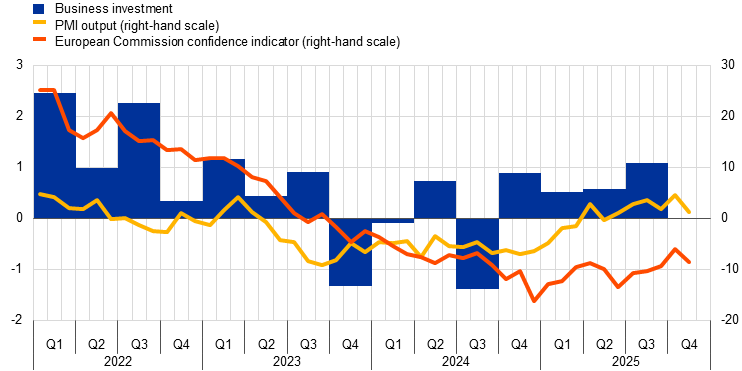
Business investment grew robustly in the third quarter and is set to increase further. In the third quarter of 2025 business investment rose by 1.8%, quarter on quarter, and by 1.1% when excluding volatile Irish intangibles. Excluding Irish intangibles, both tangible and intangible investment showed robust growth. Indicators for the capital goods sector in the fourth quarter, such as the PMI output indicator and the European Commission’s confidence survey up to November, point to some weakness in tangible investment (Chart 7, panel a). Meanwhile, surveys on intangible services up to November, such as PMI activity and the European Commission’s survey on expected demand over the next three months, indicate an ongoing rise in intangible investment. In the November Non-Financial Business Sector Dialogue (NFBD), firms reported increasing investment in e-commerce, data centres, software development and automation. Yet the NFBD revealed that high energy, labour and regulatory costs, as well as fears of overregulation of AI, remain substantial obstacles. Looking ahead, investment should be underpinned by rising overall demand, higher profits, declining uncertainty and additional defence and infrastructure initiatives, as well as the more supportive financing conditions over the past year. The simplification of EU regulations could also help accelerate investment. Nevertheless, some significant downside risks persist, as adverse effects from higher tariffs may still unfold. Firms participating in the NFBD were particularly concerned about China’s rerouting of low-price high-tech exports – given its overcapacity and reduced export opportunities to the United States – which may erode margins and lead to market share losses in Europe.
Chart 7
Real investment dynamics and survey data
a) Business investment (excluding Irish intangibles)
(quarter-on-quarter percentage changes; percentage balances and diffusion index)
b) Housing investment
(quarter-on-quarter percentage changes; percentage balances and diffusion index)
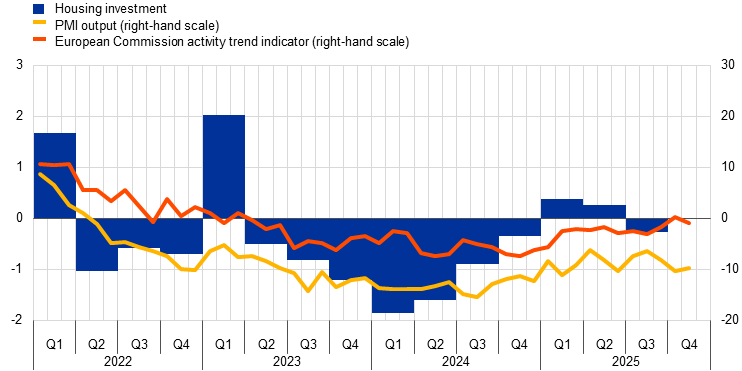
Sources: Eurostat, European Commission, S&P Global Market Intelligence and ECB calculations.
Notes: The lines indicate monthly developments, while the bars refer to quarterly data. The PMIs are expressed in terms of the deviation from 50. In panel a), business investment is measured by non-construction investment excluding Irish intangibles. Short-term indicators refer to the capital goods sector. The European Commission’s capital goods confidence indicator is normalised for the 1999-2019 average and standard deviation of the series. In panel b), the line for the European Commission’s activity trend indicator refers to the weighted average of the building and specialised construction sectors’ assessment of the trend in activity over the preceding three months, rescaled to have the same standard deviation as the PMI. The line for PMI output refers to housing activity. The latest observations are for the third quarter of 2025 for investment and November 2025 for PMI output and the European Commission’s indicators.
Housing investment declined slightly in the third quarter of 2025 but is expected to return to moderate growth in the fourth quarter. Following two consecutive quarters of expansion earlier in the year, housing investment fell by 0.3%, quarter on quarter, in the third quarter, indicating that a sustained recovery has not yet taken hold (Chart 7, panel b). Production in building construction and specialised construction activities was, on average, 0.1% higher in the third quarter than in the preceding quarter. Forward-looking indicators present a mixed picture. The European Commission’s indicator of recent trends in building and specialised construction activity strengthened in October and November compared with the third quarter, whereas the PMI housing output index declined. Overall, however, housing investment is likely to resume a gradual recovery. This assessment is supported by a continued, albeit modest, increase in residential building permits in the third quarter, as well as by the ongoing rise in new housing loans. In addition, the Consumer Expectations Survey signals a growing attractiveness of housing as an investment, pointing to strengthening housing demand (see Box 5).
Euro area total exports picked up in the third quarter of 2025, rising by 0.7%, even though the underlying momentum remains weak. Euro area exports of goods increased markedly in the third quarter of 2025, rising by 1.5% quarter on quarter. This pick-up is partly attributable to higher pharmaceutical sales to the United States, which may have reflected a frontloading of exports by firms in anticipation of possible higher tariffs on those products. It also reflected increased exports of ingredients for weight loss drugs. Beyond pharmaceuticals, the euro area continues to suffer market share losses in many destinations and sectors amid stronger competition from China. This pattern is likely to persistently weigh on euro area exports. In the third quarter of 2025 imports of goods saw a moderate increase of 0.7%, with Chinese imports continuing to grow amid intensifying competition for euro area firms. At the same time, import prices continued to decline, falling by 2% in August in annual terms, reflecting the impact of the past appreciation of the euro and downward price pressures from China. Looking ahead, survey indicators continue to signal weakness in both manufacturing and services exports.
Compared with the September 2025 projections, real GDP growth has been revised up by 0.2 percentage points for 2025 and 2026 and by 0.1 percentage points for 2027. The upward adjustment for 2025 reflects revisions to past data, including the better than expected outturn for the third quarter of 2025. The somewhat lower trade policy uncertainty, stronger foreign demand and lower energy commodity prices have led to the upward revision to the growth outlook for 2026. Marginally stronger quarterly dynamics and a larger carry-over effect from the stronger growth momentum in 2026 together entail a small upward revision to the outlook for 2027. In terms of expenditure components, the largest upward revisions for 2025-27 relate to investment and, in particular, stronger business investment over the whole horizon and more dynamic government investment in 2027, as well as stronger government consumption in 2025-26. Net trade has also been revised up for 2025, reflecting the better than expected performance of exports in the first three quarters of the year.
3 Prices and costs
Annual euro area headline inflation, as measured by the Harmonised Index of Consumer Prices (HICP), continues to stand close to the Governing Council’s 2% medium-term target. It remained at 2.1% in November 2025[4], as an increase in energy inflation was offset by a decline in food inflation. HICP excluding energy and food (HICPX) inflation was steady at 2.4%, as goods inflation and services inflation moved in opposite directions. Indicators of underlying inflation have changed little in recent months and remain consistent with the 2% target. While growth in unit profits was unchanged in the third quarter of 2025, unit labour costs grew at a slightly higher rate than in the second quarter. The year-on-year growth in compensation per employee was unchanged at 4.0% in the third quarter. Most measures of longer-term inflation expectations continue to stand at around 2%, supporting the stabilisation of inflation around the target.
The December 2025 Eurosystem staff macroeconomic projections for the euro area foresee headline inflation decreasing from 2.1% in 2025 to 1.9% in 2026 and then to 1.8% in 2027, before returning to the Governing Council’s medium-term target of 2% in 2028. Compared with the September 2025 projections, headline inflation has been revised up for 2026 and revised down slightly for 2027.[5]
Euro area HICP inflation remained at 2.1% in November 2025 (Chart 8). This result follows a modest pick-up in services inflation and an increase in the energy component, which were offset by lower non-energy industrial goods (NEIG) inflation and food inflation. The annual rate of change in energy prices rose to -0.5% in November, up from -0.9% in October, driven by an increase in the transportation fuels component, which outweighed the declines in the electricity and gas components. Total food inflation edged down to 2.4% in November, from 2.5% in October. Looking at the individual food sub-components, the annual rate of change in processed food prices decreased slightly to 2.2% in November, from 2.3% in October, while that in unprocessed food prices was unchanged at 3.2%. HICPX inflation was stable for the third month in a row in November, standing at 2.4%. This reflects a modest decline in NEIG inflation to 0.5%, from 0.6% in October, which offset an equally sized increase in services inflation, up to 3.5% from 3.4% over the same period. Services inflation has been on an upward path in recent months, driven by higher annual rates of growth in the recreation sub-component – particularly for accommodation and package holidays – as well as in the transport and communication sub-components. Looking ahead, although services price pressures remain strong, the expected gradual easing of wage growth should contribute to services disinflation.
Chart 8
Headline inflation and its main components
(annual percentage changes; percentage point contributions)
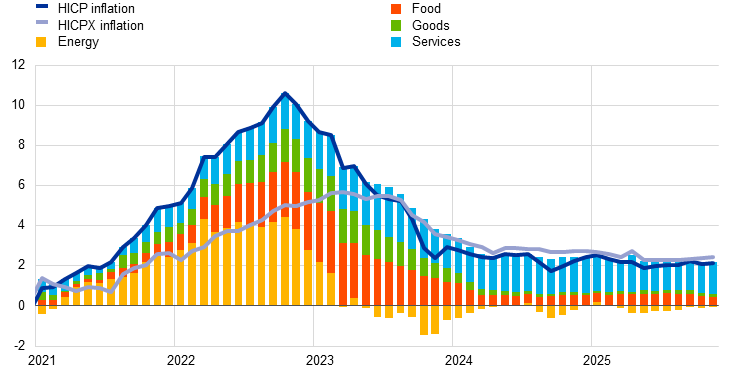
Sources: Eurostat and ECB calculations.
Notes: “Goods” refers to non-energy industrial goods. HICPX stands for HICP excluding energy and food. The latest observations are for November 2025.
Indicators of underlying inflation have changed little over recent months and remain consistent with the ECB’s 2% medium-term target (Chart 9). In November 2025, most measures of underlying inflation moved sideways and the range of indicator values was between 2.0% and 2.5%.[6] All permanent exclusion-based measures of inflation were unchanged from October, remaining between 2.4% and 2.5%. Movements in most temporary exclusion-based measures also pointed to a stabilisation of underlying inflation pressures in November. Domestic inflation, which includes mostly services items, increased slightly to 3.6% in November, from 3.5% in October. As for the model-based measures, the Persistent and Common Component of Inflation decreased to 2.0% in November, while the Supercore indicator, which comprises HICP items sensitive to the business cycle, held steady at 2.5% for the fifth consecutive month.
Chart 9
Indicators of underlying inflation
(annual percentage changes)
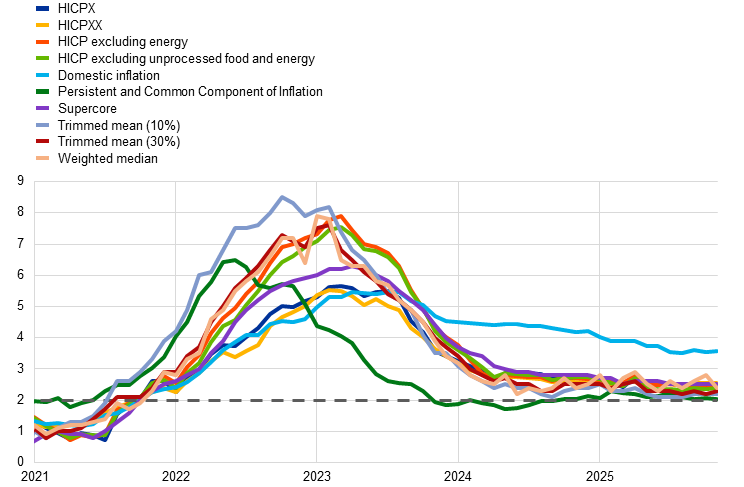
Sources: Eurostat and ECB calculations.
Notes: The grey dashed line represents the Governing Council’s inflation target of 2% over the medium term. HICPX stands for HICP excluding energy and food; HICPXX stands for HICPX excluding travel-related items, clothing and footwear. The latest observations are for November 2025.
Measures of pipeline pressures indicate a gradual easing of inflation pressures (Chart 10). At the early stages of the pricing chain, producer price inflation for energy fell significantly, down to ‑3.9% in October 2025 from ‑2.4% in September, well below its peak of 7.8% in February. Over the same period, for intermediate goods, the annual growth rate of domestic producer prices increased to 0.1%, up from ‑0.1%, while that of import prices remained unchanged at ‑0.8%. At the later stages of the pricing chain, for non-food consumer goods, domestic producer price inflation remained unchanged at 1.5% in October, while import price inflation declined to ‑1.6% from ‑1.2% in September. At the same time, for manufactured food, the annual growth rate of producer prices decreased to 1.1%, down from 1.7%, while that of import prices continued to fall from its peak of 10.6% in January, dropping to 2.8% in October from 4.9% in September. Overall, the data suggest that pipeline pressures for both consumer goods and food have been easing, reflecting the appreciation of the euro and, possibly, China’s increased focus on the euro area as an export market, putting downward pressure on import prices.
Chart 10
Indicators of pipeline pressures
(annual percentage changes)
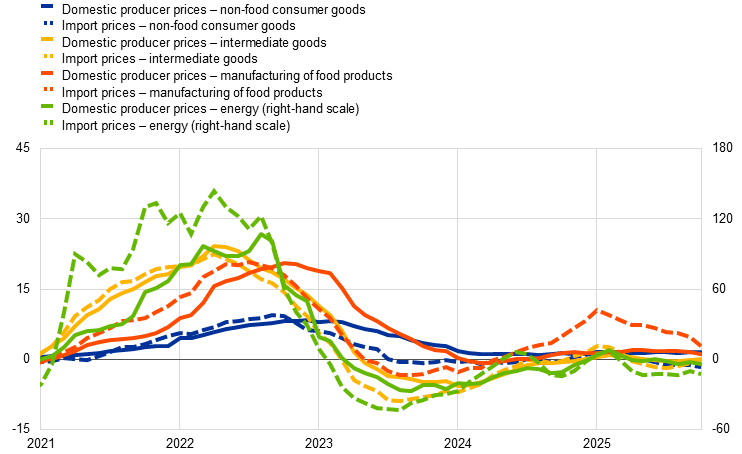
Sources: Eurostat and ECB calculations.
Note: The latest observations are for October 2025.
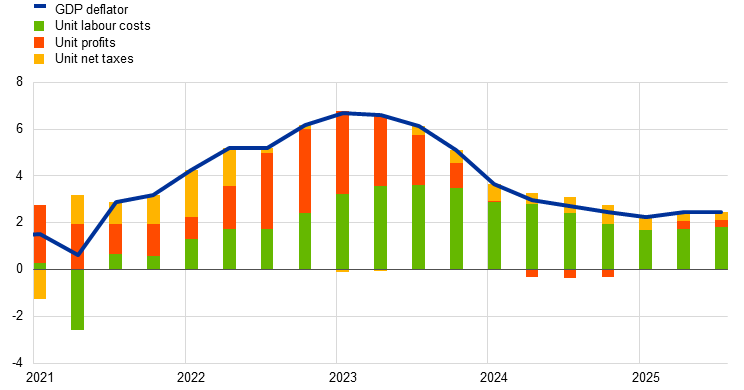
Domestic cost pressures, as measured by growth in the GDP deflator, remained broadly stable at 2.4% in the third quarter of 2025 (Chart 11). This reflected an uptick in the contribution from unit labour costs, which was offset by a stable contribution from unit profits and a decrease in that from unit net taxes. The slight increase in the yearly growth rate of unit labour costs was due to a moderate decline in the growth rate for labour productivity, down to 0.7% in the third quarter from 0.8% in the second quarter, and a stable growth rate for compensation per employee, which stood at 4.0% in the third quarter. The latter mirrored a decline in negotiated wage growth, down to 1.9% in the third quarter from 4.0% in the previous quarter, which was offset by a substantial increase in the wage drift component over the same period. The sharp drop in negotiated wage growth reflects the mechanical impact of large one-off payments made in 2024, which, at the same time, was also causing the volatility in the wage drift. Looking ahead, the ECB’s wage tracker, which incorporates data on wage agreements negotiated up to the end of November 2025, continues to indicate that wage growth pressures will remain moderate in both the fourth quarter of 2025 and first half of 2026, before stabilising gradually in the second half of 2026.[7] The December 2025 Eurosystem staff macroeconomic projections for the euro area expect growth in compensation per employee to stand at 4.0%, on average, for 2025 and to moderate to 3.2% in 2026, 2.9% in 2027 and 3.0% in 2028.
Chart 11
Breakdown of the GDP deflator
(annual percentage changes; percentage point contributions)
Sources: Eurostat and ECB calculations.
Notes: Compensation per employee contributes positively to changes in unit labour costs. Labour productivity contributes negatively. The latest observations are for the third quarter of 2025.
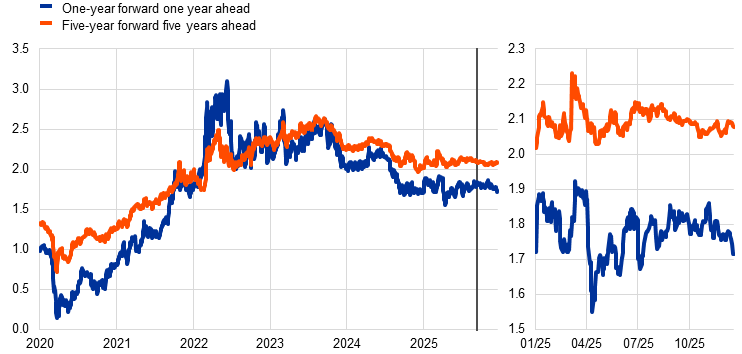
During the review period from 11 September to 17 December 2025, market-based measures of inflation compensation (Chart 12, panel a) were largely unchanged, as were longer-term inflation expectations among professional forecasters and monetary analysts. The one-year forward inflation‑linked swap rate one year ahead, a market-based measure of short-term inflation compensation, remained broadly stable at around 1.8%. Inflation-linked markets appeared not to react strongly to the European Council’s decision on 5 November 2025 to postpone the implementation of the EU Emissions Trading System 2 (ETS2) by one year, from 2027 to 2028. At medium and longer‑term maturities, inflation compensation was similarly stable. The five‑year forward inflation-linked swap rate five years ahead, adjusted for inflation risk premia, remained close to 2%. This suggests that longer-term market-based expectations remain well anchored to the Governing Council’s inflation target. In both the ECB Survey of Professional Forecasters for the fourth quarter of 2025 and the ECB Survey of Monetary Analysts for December 2025, average and median longer-term inflation expectations remained at 2%.
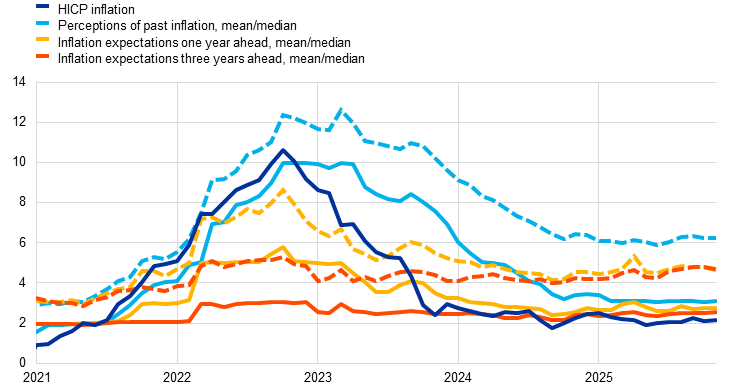
Consumer perceptions of past inflation, as well as their short and medium-term inflation expectations, remained stable in November 2025 (Chart 12, panel b). According to the ECB Consumer Expectations Survey for November 2025, the median rate of perceived inflation over the previous 12 months remained stable at 3.1%, unchanged since February 2025. Median expectations for headline inflation over the next 12 months (2.8%) and three years ahead (2.5%) have also remained unchanged since October and July respectively.
Chart 12
Market-based measures of inflation compensation and consumer inflation expectations
a) Market-based measures of inflation compensation
(annual percentage changes)
b) Headline HICP inflation and ECB Consumer Expectations Survey
(annual percentage changes)
Sources: LSEG, Eurostat, ECB Consumer Expectations Survey and ECB calculations.
Notes: Panel a) shows forward inflation-linked swap rates over different time horizons for the euro area. The vertical grey line indicates the start of the review period on 11 September 2025. In panel b), the dashed lines show the mean rate and the solid lines show the median rate. The latest observations are for 17 December 2025 for panel a) and November 2025 for the measures in panel b).
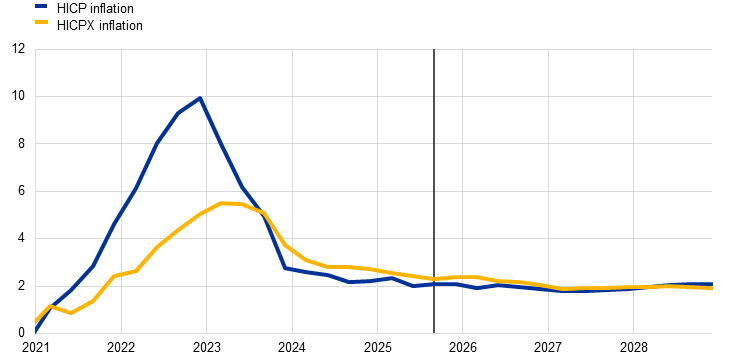
The December 2025 projections expect headline inflation to average 2.1% in 2025, 1.9% in 2026 and 1.8% in 2027, before returning to the Governing Council’s medium-term target of 2% in 2028 (Chart 13). Headline inflation is expected to remain at 2.1% in the last quarter of 2025, before falling somewhat below 2.0% in 2026 and remaining at those lower levels in 2027. The lower average rate projected for 2026 is related to energy base effects in the first quarter, weaker food inflation, and a decline in HICPX inflation owing to a moderation in services inflation. The further decrease in headline inflation in 2027 reflects a continued decline in HICPX inflation, which is partly offset by a reversion of energy inflation to zero rates, while food inflation should remain unchanged. Headline inflation is then expected to rise in 2028, driven mainly by a significant increase in energy inflation owing to climate transition-related fiscal measures and, in particular, the introduction of the ETS2 scheme. Compared with the September 2025 projections, the outlook for headline inflation remains unchanged for 2025, whereas it has been revised upwards by 0.2 percentage points for 2026 and revised downwards by 0.1 percentage points for 2027. The upward revision for 2026 mainly reflects a stronger services inflation outlook, while the downward revision for 2027 is primarily due to the expected postponement of ETS2, partly offset by stronger services inflation. HICPX inflation is projected to decline from 2.4% in 2025 to 2.2% in 2026 and then to stabilise at or close to 2% towards the end of the projection horizon, driven by fading labour cost pressures on services inflation. Compared with the September 2025 projections, HICPX inflation is unchanged for 2025, while it has been revised upwards by 0.3 percentage points for 2026 and 0.1 percentage points for 2027.
Chart 13
Euro area HICP and HICPX inflation
Sources: Eurostat and Eurosystem staff macroeconomic projections for the euro area, December 2025.
Notes: The grey vertical line indicates the last quarter before the start of the projection horizon. The latest observations are for the third quarter of 2025 for the data and the fourth quarter of 2028 for the projections. The December 2025 projections were finalised on 3 December 2025 and the cut-off date for the technical assumptions was 26 November 2025. Both historical and projected data for HICP and HICPX inflation are reported at a quarterly frequency.
4 Financial market developments
Euro area short and long-term risk-free rates increased during the review period from 11 September to 17 December 2025, with markets effectively pricing out further interest rate cuts. Long-term sovereign bond yields ended the review period higher but spreads relative to risk-free rates narrowed. The increase in risk-free rates and sovereign yields was in line with a broader trend that saw yield curves steepen globally, largely on the back of a rise in real rates. Euro area equity markets recorded gains over the review period, notwithstanding temporary setbacks amid concerns about the valuations of artificial intelligence (AI) companies in the United States. Spreads in corporate bond markets narrowed further and currently stand at record lows, sustained by elevated risk appetite. In foreign exchange markets, the euro remained stable both against the US dollar (+0.3%) and in trade-weighted terms (+0.4%). The stability against the US dollar reflected better than expected macroeconomic developments in both the euro area and the United States, while the trade-weighted stability was due to offsetting exchange rate movements against trading partners.
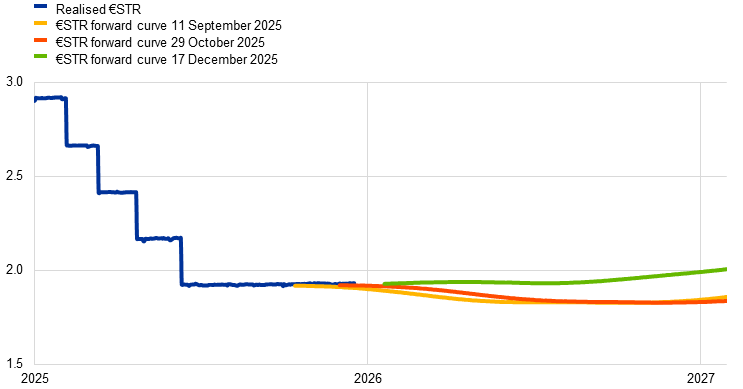
Short and long-term risk-free rates in the euro area went up during the review period (Chart 14). The benchmark euro short-term rate (€STR) stood at 1.93% at the end of the review period, following the Governing Council’s decisions to keep the three key ECB interest rates unchanged at its September and October meetings. Excess liquidity decreased by around €164 billion to €2,486 billion, mainly reflecting the continuing decline in the portfolios of securities held for monetary policy purposes. Very near-term forward rates rose over the review period, as markets priced out expectations of further interest rate cuts. The resurfacing of global trade uncertainty, which was mainly due to heightened tensions between the United States and China, prompted a brief decline in risk-free rates during October. This decrease was subsequently reversed amid improving trade sentiment, as the United States signed trade agreements with a number of Asian countries and geopolitical tensions in the Middle East declined. Following the Governing Council meeting on 30 October 2025, near-term policy rate expectations drifted higher as incoming data releases signalled that the euro area economy remained resilient. By the end of the review period, the €STR forward curve was pricing in cumulative interest rate hikes of 6 basis points by the end of 2026, a reversal from the cumulative interest rate cuts of 8 basis points that were priced in at the start of the review period. Looking beyond 2027, the €STR forward curve shifted upwards across all maturities, in line with a global steepening in yield curves driven mainly by higher real rates. Overall, the ten-year nominal overnight index swap (OIS) rate increased to 2.7% over the review period.
Chart 14
€STR forward rates
(percentages per annum)
Sources: Bloomberg Finance L.P. and ECB calculations.
Note: The forward curve is estimated using spot OIS (€STR) rates.
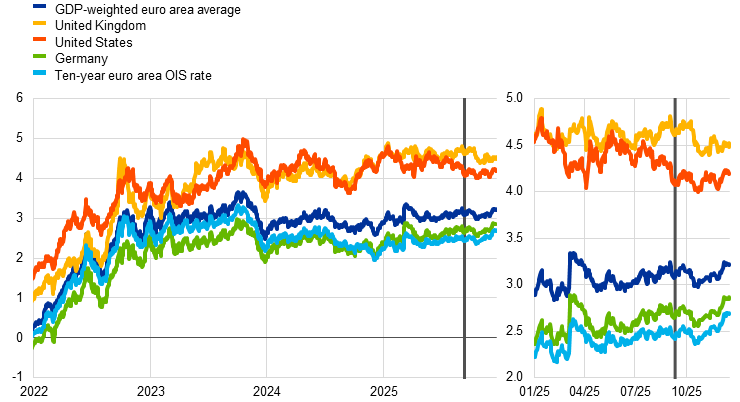
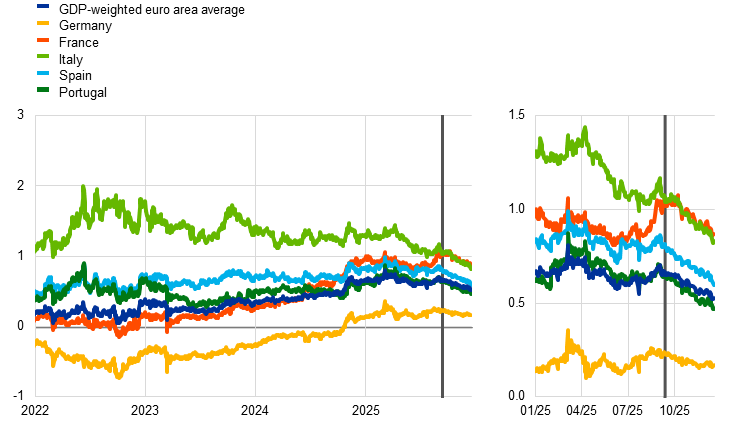
Long-term sovereign bond yields ended the review period higher, while spreads relative to risk-free rates narrowed (Charts 15 and 16). The ten-year GDP-weighted euro area sovereign bond yield rose by 14 basis points over the review period, to stand at around 3.2%. Sovereign spreads relative to risk-free OIS rates narrowed, reflecting strong risk appetite across asset classes and a favourable market reassessment of the fiscal outlook for some countries, such as Spain and Italy. French sovereign yields performed similarly to those of other euro area countries, as political uncertainty in France waned. Meanwhile, a downgrade in France’s sovereign credit rating prompted only a short-lived reaction in financial markets. Cross-country dispersion in sovereign spreads over risk-free rates declined throughout the review period, reaching historically low levels.
Chart 15
Ten-year sovereign bond yields and the ten-year OIS rate based on the €STR
(percentages per annum)
Sources: LSEG and ECB calculations.
Notes: The vertical grey line denotes the start of the review period on 11 September 2025. The latest observations are for 17 December 2025.
Chart 16
Ten-year euro area sovereign bond spreads vis-à-vis the ten-year OIS rate based on the €STR
(percentage points)
Sources: LSEG and ECB calculations.
Notes: The vertical grey line denotes the start of the review period on 11 September 2025. The latest observations are for 17 December 2025.
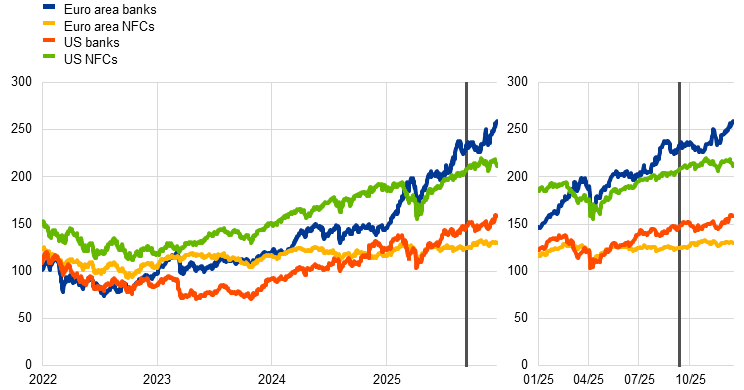
Euro area equity market indices moved higher over the review period, in spite of temporary setbacks reflecting concerns about AI‑related valuations (Chart 17). Euro area stock market indices gained 4.9% over the review period, with the sub-index for non-financial corporations (NFCs) rising by 4% and bank stock prices increasing by 10.6%. Euro area financial equities gained on account of a sustained increase in equity market valuations, underpinned by robust balance sheets and elevated profitability. US stock market indices strengthened by around 1.3%, with increases of 1.5% for NFCs and 6.8% for banks. The broader index for US financial firms went up by 1.1%. Despite the overall gains in both the euro area and the United States, investor unease about the valuations of US AI equities triggered a period of sell-off in November. However, subsequent strong earnings reports from some of the major AI-related firms helped to alleviate these concerns. Overall, euro area equities outperformed their US peers, owing partly to market reservations about stretched valuations, declining cash levels and growing financial interdependencies between AI companies in the United States.
Chart 17
Euro area and US equity price indices
(index: 1 January 2020 = 100)
Sources: LSEG and ECB calculations.
Notes: The vertical grey line denotes the start of the review period on 11 September 2025. The latest observations are for 17 December 2025.
In corporate bond markets, spreads on investment-grade and high-yield bonds narrowed further and are currently at record lows. Risk appetite remained high over the review period and supported favourable financing conditions in corporate bond markets, with spreads in the investment-grade and high-yield segments tightening by approximately 2 and 15 basis points respectively. Investment-grade spreads narrowed by 4 basis points for NFCs and remained broadly unchanged for financial firms. In the high-yield segment, spreads tightened by 19 basis points for NFCs and widened by around 35 basis points for financial corporations.
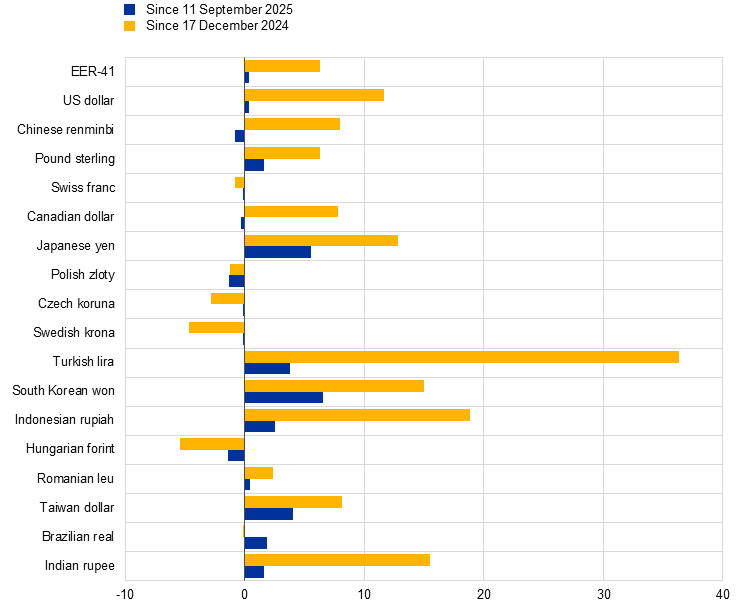
In foreign exchange markets, the euro was stable both against the US dollar and in trade-weighted terms (Chart 18). During the review period, the nominal effective exchange rate of the euro – as measured against the currencies of 41 of the euro area’s most important trading partners – was stable (+0.4%). This stability reflected offsetting changes against different trading partners. Notably, the euro appreciated against the Japanese yen (+5.5%) and pound sterling (+1.6%), which reflected uncertainties surrounding the fiscal and monetary policy outlook in Japan and the United Kingdom. The upward pressure on the euro was compensated by a depreciation against the Chinese renminbi (-0.8%) and Polish zloty (-1.3%). The euro remained stable against the US dollar (+0.3%) and hovered near its historical average of 1.18 during the review period, as the significant strengthening seen earlier this year levelled off. This stability reflected better than anticipated macroeconomic developments in both the euro area and United States, along with broadly unchanged relative monetary policy expectations.
Chart 18
Changes in the exchange rate of the euro vis-à-vis selected currencies
(percentage changes)
Source: ECB calculations.
Notes: EER-41 is the nominal effective exchange rate of the euro against the currencies of 41 of the euro area’s most important trading partners. A positive (negative) change corresponds to an appreciation (depreciation) of the euro. All changes have been calculated using the foreign exchange rates prevailing on 17 December 2025.
5 Financing conditions and credit developments
Bank lending rates for firms have been broadly stable since the summer, after falling in response to the ECB’s past interest rate cuts. In October average interest rates on new loans to firms and on new mortgages remained at 3.5% and 3.3% respectively. Growth in loans to firms and households increased further but stayed moderate overall. Over the review period from 11 September to 17 December 2025, the cost of both market-based debt and equity financing rose, driven by higher risk-free rates. The annual growth rate of broad money (M3) was unchanged at 2.8% in October.
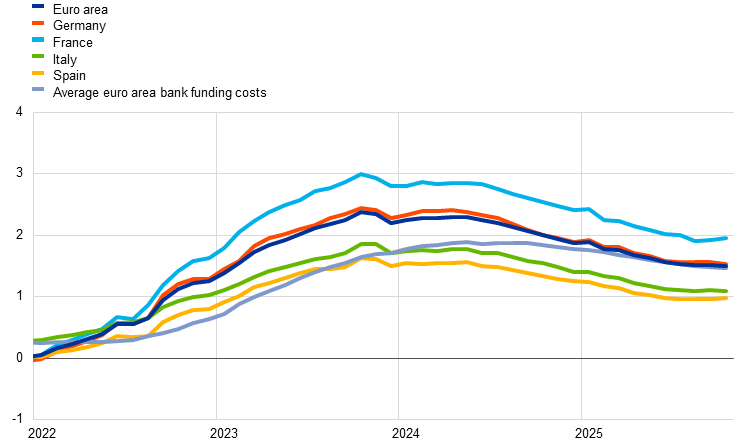
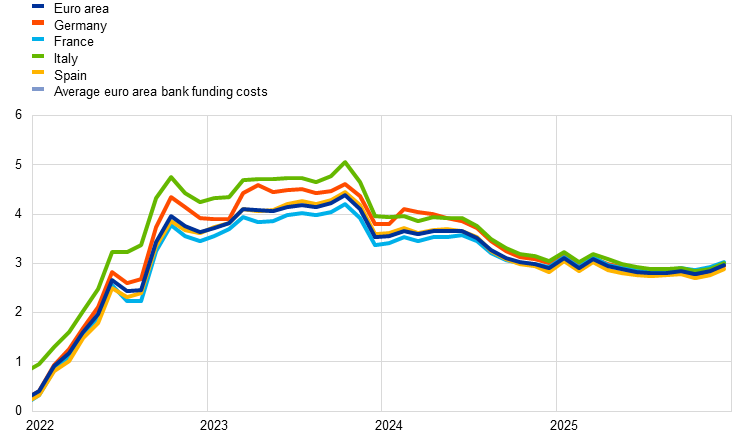
Bank funding costs were broadly stable in October 2025. The composite cost of debt financing for euro area banks stood at 1.5% in October (Chart 19, panel a). Bank bond yields stayed close to 3%, as indicated by data available in mid-December (Chart 19, panel b). Interest rates on overnight deposits and deposits redeemable at notice as well as interbank rates saw little change in October, while those on time deposits for households increased slightly. The gap between interest rates on time deposits and overnight deposits for both firms and households was broadly unchanged in October. The composite deposit rate remained stable at 0.9% in October, around 60 basis points below its May 2024 peak.
Chart 19
Composite bank funding costs in selected euro area countries
a) Banks’ composite cost of debt financing
(annual percentages)
b) Bank bond yields
(annual percentages)
Sources: ECB, S&P Dow Jones Indices LLC and/or its affiliates, and ECB calculations.
Notes: Composite bank funding costs are an average of new business costs for overnight deposits, deposits redeemable at notice, time deposits, bonds and interbank borrowing, weighted by their respective outstanding amounts. Average bank funding costs use the same weightings but are based on rates for outstanding deposits and interbank funding, and on yield to maturity at issuance for bonds. Bank bond yields are monthly averages for senior tranche bonds. The latest observations are for October 2025 for the composite cost of debt financing for banks (panel a) and 17 December 2025 for bank bond yields (panel b).
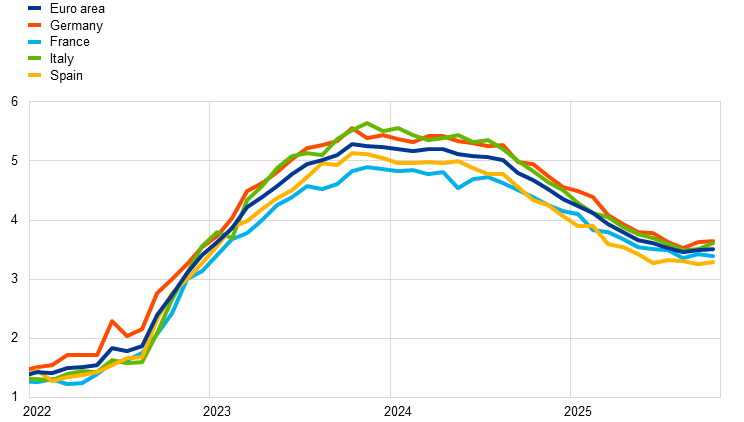
Bank lending rates for firms and households have stabilised since September, against the backdrop of unchanged policy rates and limited moves in longer-term rates. The cost of bank borrowing for non-financial corporations (NFCs) remained unchanged at 3.5% in October 2025, around 1.8 percentage points down from its October 2023 peak, with minor variations across the larger euro area countries (Chart 20, panel a). The spread between interest rates on small and large loans to firms remained broadly stable in October, with uneven developments across the largest euro area economies. The cost of borrowing for households for house purchase was unchanged at 3.3% in October, around 70 basis points below its November 2023 peak, with some variation across the larger euro area countries (Chart 20, panel b). The gap between lending rates for households and those for firms, which had peaked at 140 basis points in March 2024, was stable at 20 basis points. The size of this gap mainly reflects the fact that loans to households typically have longer rate fixation periods in many euro area countries, making them less sensitive to fluctuations in short-term market rates.
Chart 20
Composite bank lending rates for firms and households in selected euro area countries
a) Rates on loans to NFCs
(annual percentages)
b) Rates on loans to households for house purchase
(annual percentages)
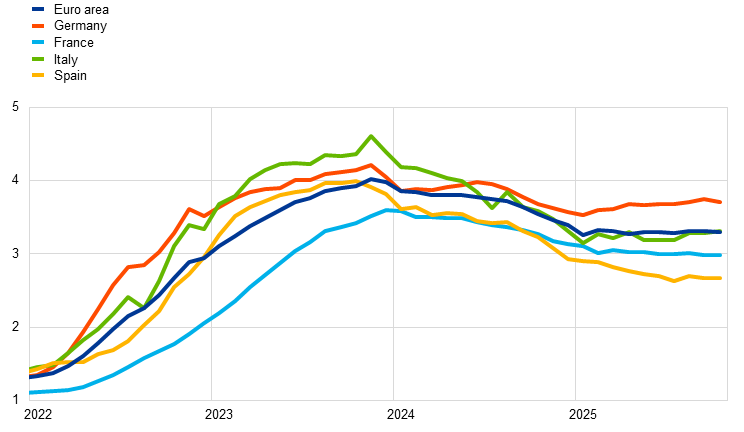
Sources: ECB and ECB calculations.
Notes: Composite bank lending rates are calculated by aggregating short and long-term rates using a 24-month moving average of new business volumes. The latest observations are for October 2025. In panel a), NFCs stands for non-financial corporations.
Over the review period from 11 September to 17 December 2025 the cost of both market-based debt and equity financing increased. The overall cost of financing for NFCs – the composite cost of bank borrowing, market-based debt and equity – was stable in October at 5.7%, unchanged from the previous month (Chart 21).[8] This stability reflected a higher cost of equity financing that was broadly offset by a decline in the cost of market-based debt observed in October relative to the previous month. Meanwhile, the cost of bank borrowing remained almost unchanged. Daily data for the entire review period from 11 September to 17 December 2025 show upward movements in both the cost of market-based debt and, to a lesser extent, the cost of equity financing. The increase in the cost of market-based debt was driven by the upward shift in risk-free rates while corporate bond spreads declined marginally. Similarly, the rise in the risk-free rate, as approximated by the ten-year overnight index swap rate, led to the increase in the cost of equity, despite a slight decline in the equity risk premium.
Chart 21
Nominal cost of external financing for euro area firms, broken down by component
(annual percentages)
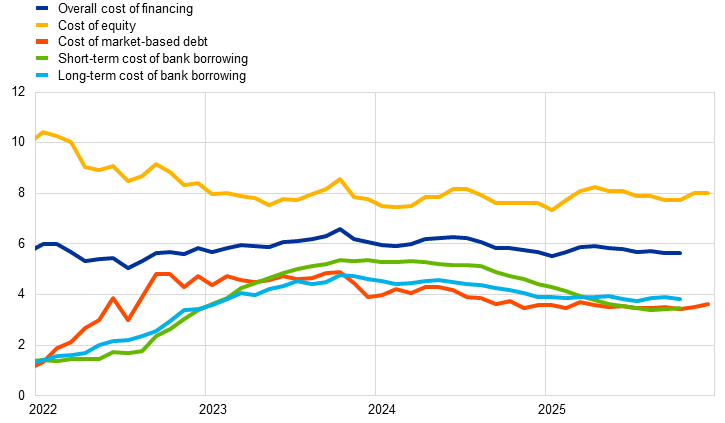
Sources: ECB, Eurostat, Dealogic, Merrill Lynch, Bloomberg Finance L.P., LSEG and ECB calculations.
Notes: The overall cost of financing for non-financial corporations is based on monthly data and is calculated as a weighted average of the long and short-term costs of bank borrowing (monthly average data), market-based debt and equity (end-of-month data), based on their respective outstanding amounts. The latest observations are for 17 December 2025 for the cost of market-based debt and the cost of equity (daily data) and October 2025 for the overall cost of financing and the cost of borrowing from banks (monthly data).
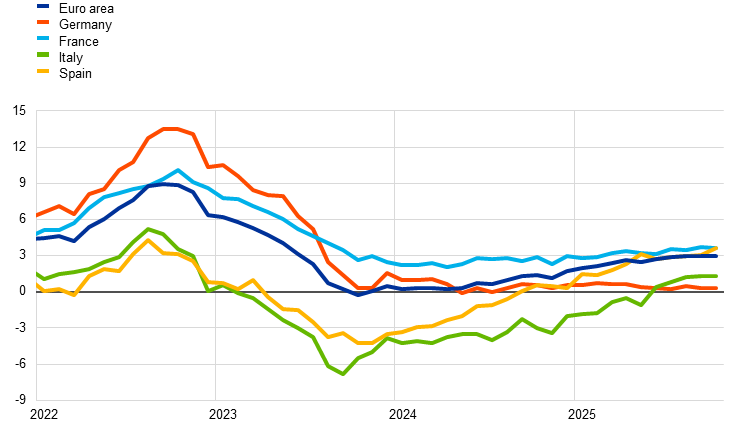
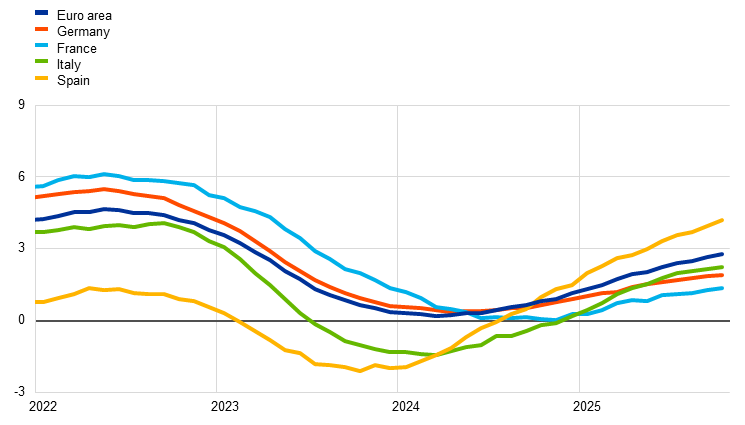
Growth in loans to firms and households remained moderate and below historical averages. The annual growth rate of bank lending to firms was 2.9% in October 2025, unchanged from September. This rate had been gradually increasing since the beginning of 2025 but is still below its historical average of 4.3% (Chart 22, panel a). The annual growth in corporate debt financing rose slightly to 3.2% in October but remains well below its historical average of 4.8%. The ECB’s October 2025 euro area bank lending survey revealed increased risk aversion among banks. It indicated a small, unexpected net tightening of credit standards for loans to firms and a slight net increase in demand for new loans which, however, remained weak overall. Loans to households continued to gradually recover, with the annual growth rate rising to 2.8% in October from 2.6% in September, still significantly below the historical average of 4.1% (Chart 22, panel b). Loans to households for house purchase and consumer credit growth both supported this upward trend. Other forms of lending to households, including loans to sole proprietors, remained weak. According to the ECB’s most recent Consumer Expectations Survey, households perceived credit access to be slightly harder in October, although they expected it to remain stable over the next 12 months. The still relatively slow pace of growth in loans partly reflects higher levels of uncertainty about global economic policies. This factor was particularly prevalent in the first half of 2025, stemming, among other things, from trade policy developments in the United States.[9]
Chart 22
MFI loans in selected euro area countries
a) MFI loans to NFCs
(annual percentage changes)
b) MFI loans to households
(annual percentage changes)
Sources: ECB and ECB calculations.
Notes: Loans from monetary financial institutions (MFIs) are adjusted for loan sales and securitisation; in the case of non-financial corporations (NFCs), loans are also adjusted for notional cash pooling. The latest observations are for October 2025.
Annual growth in broad money (M3) stabilised in October, supported by stable dynamics in household and firm loans and deposits (Chart 23). The progressive decline in M3 growth seen since February 2025 halted in October as annual M3 growth was unchanged at 2.8%. This is well below the 4% rate reached in the first part of 2025 and its long-term average of 6.1%. Annual growth in narrow money (M1), which comprises the most liquid components of M3, increased at a relatively stable rate, to 5.2% in October from 5.0% in September. M1 growth continued to be driven by overnight deposits, reflecting a strong preference for liquid assets among firms and households. From a counterpart perspective, loans to households and firms continued to make a moderate contribution to money creation. Net foreign monetary inflows appear to have lost strength and have become more volatile compared with 2024. Banks’ purchases of government bonds were sustaining money growth in an environment of robust bond supply. This was amid the ongoing contraction of the Eurosystem balance sheet with a passive runoff of the asset purchase programme and pandemic emergency purchase programme portfolio which continued to weigh on M3 growth.
Chart 23
M3, M1 and overnight deposits
(annual percentage changes, adjusted for seasonal and calendar effects)

Source: ECB.
Note: The latest observations are for October 2025.
6 Fiscal developments
According to the December 2025 Eurosystem staff macroeconomic projections, the euro area general government budget deficit is expected to decline from 3.1% of GDP in 2024 to 3.0% of GDP in 2025 and then increase to 3.5% of GDP in 2027 before moderating to 3.4% of GDP in 2028. Broadly reflecting this path, the euro area fiscal stance is projected to tighten slightly in 2025, loosen in 2026 and then tighten again in 2027 and 2028. However, the fiscal policy assumptions and projections continue to be surrounded by a high degree of uncertainty.[10] The European Commission has adopted the 2026 Autumn Package and expects the majority of Member States to be compliant with their commitments or to be at limited risk of being non-compliant, taking into account the activation of the national escape clause. At the same time, it is welcome that nationally financed investments are expanding in the euro area as a whole. Governments should prioritise sustainable public finances, strategic investment and growth-enhancing structural reforms.
According to the December 2025 Eurosystem staff macroeconomic projections, the euro area general government budget balance is set to improve gradually over the projection horizon (Chart 24).[11] After a slight decline expected in 2025, the euro area budget deficit is projected to increase rather strongly to 3.5% of GDP in 2027 and to moderate only slightly to 3.4% of GDP in 2028. This increase reflects rising interest payments (from 1.9% of GDP in 2024 to 2.3% in 2028), which are only marginally offset by the impact of the economic cycle. Hence, the cyclical component remains broadly neutral over the projection horizon, turning slightly positive in 2028, and the cyclically adjusted primary balance remains broadly unchanged (when accounting for Next Generation EU (NGEU) grants). Compared with the September 2025 ECB staff projections, the projected budget balance path has been revised down slightly over 2025-27, mainly on account of the cyclically adjusted primary balance, which more than offsets the slight improvement in the cyclical component.
After a slight tightening in 2025, the euro area fiscal stance is projected to loosen in 2026 and tighten again in 2027 and 2028.[12] The annual change in the cyclically adjusted primary balance, adjusted for grants extended to countries under the NGEU programme, points to a modest tightening over the coming years, except in 2026. The tightening in 2025 is mostly due to discretionary revenue measures, including increases in social security contributions and, to a lesser extent, increases in direct and indirect taxes. These increases were partly offset by continued growth in public spending. In 2026 the fiscal stance is projected to loosen, mainly on account of higher public investment. In 2027 consolidation in many countries (following, among other factors, the expiry of NGEU financing) is offset by stimulus, particularly in Germany. In addition, deferred NGEU-funded spending, mainly in Spain and Italy, mitigates the fiscal stance tightening in 2027. In 2028 the euro area fiscal stance is expected to continue tightening, albeit at a somewhat slower pace than in 2027. However, the modest tightening masks country heterogeneity, as a strongly loosening fiscal stance in Germany compensates for significant tightening in France, Spain and Italy. The tightening in Spain and Italy largely stems from a lower level of spending, mainly on capital transfers and investment previously financed from NGEU funding.
The euro area debt-to-GDP ratio is set on a rising path (Chart 25). The euro area debt-to-GDP ratio is projected to increase from 86.6% in 2024 to 89.2% in 2028 as primary deficits and positive deficit-debt adjustments outweigh the favourable, though diminishing, effects of interest rate-growth differentials. Compared with the September 2025 projections, the government debt path has been revised down. The downward revision reflects base effects from statistical revisions in 2024 and more favourable interest rate-growth differentials.
On 25 November the European Commission adopted its 2026 Autumn Package, setting out economic and employment policy priorities. This package contains the Commission’s assessment of EU Member States’ compliance with the EU fiscal framework and provides guidance for their fiscal policies in 2026. It also includes the Commission’s assessment of euro area countries’ draft budgetary plans (DBPs) for 2026. However, not all euro area countries had submitted their budgetary plans to the Commission, mainly owing to their electoral cycles.[13] It is encouraging that, based on the Commission analysis, a majority of Member States are expected to be compliant with their commitments or at limited risk of being non-compliant, taking into account the activation of the national escape clause. It is also welcome that nationally financed investments are expanding in the euro area as a whole. Governments should prioritise sustainable public finances, strategic investment and growth-enhancing structural reforms.
1 Bulgaria adopts the euro
Prepared by Matteo Falagiarda, Christine Gartner and Steffen Osterloh
On 1 January 2026 Bulgaria adopted the euro and became the 21st member of the euro area. The assessments set out in the latest convergence reports of the European Commission (2025) and the European Central Bank (ECB, 2025) paved the way for Bulgaria to adopt the euro and thereby further enlargement of the euro area following Croatia joining in 2023.[14] On 8 July 2025 the Council of the European Union formally approved the accession of Bulgaria to the euro area and determined a Bulgarian lev conversion rate of 1.95583 levs per euro. This rate had been the central rate of the lev during the country’s participation in the exchange rate mechanism (ERM II).[15] Bulgaria’s adoption of the euro demonstrates that euro area membership remains an attractive prospect in times of high uncertainty and geopolitical tensions.
More2 From text to trouble: understanding the limits of text-derived trade policy uncertainty measures
Prepared by Maximilian Schröder
Trade policy uncertainty has risen significantly in the face of higher tariffs and tariff threats, adding a new layer of complexity to assessing the global economic outlook. Shifts in tariff and trade policy, unpredictable communication and the move away from rules-based multilateralism towards bilateral leverage have heightened uncertainty for firms and investors. This has influenced sourcing, production and investment decisions, and may weigh on trade dynamics, investment and overall macroeconomic performance. Moreover, uncertainty can affect expectations and dampen activity even in the absence of concrete policy changes. Monitoring it has therefore become crucial to assessing the economic outlook. Trade policy uncertainty has been an important part of the technical assumptions underlying recent rounds of the Eurosystem/ECB staff macroeconomic projections for the euro area.[16]
More3 Tracking trade in real time: augmenting the nowcasting toolkit with satellite data
Prepared by Rinalds Gerinovics and Baptiste Meunier
Recent shocks have underscored the importance of and challenges associated with monitoring global trade in a timely manner. The large effects of post-COVID-19 pandemic supply bottlenecks (2021-22), disruptions in the Panama Canal (2023) and the Red Sea (2024-25), and recent tariff escalations have highlighted the need for timely trade monitoring. This box outlines how the inclusion of real-time indicators derived from satellite data on vessel movements in an otherwise standard tracker can provide timely insights into global trade dynamics. The augmented tracker currently indicates subdued but improving trade dynamics.
More4 The household saving rate revisited: recent dynamics and underlying drivers
Prepared by Maria Dimou, Marco Flaccadoro and Johannes Gareis
After falling back from its pandemic-related peak, the household saving rate rose again from mid-2022 to mid-2024 and has since remained broadly stable at an elevated level (Chart A). The seasonally adjusted household saving rate, as reported in Eurostat’s quarterly sector accounts (QSA), averaged around 13% between 1999 and 2019. After surging during the pandemic, in the second quarter of 2022 it returned to levels close to the historical average, before subsequently starting to rise again, reaching 15.4% by mid-2024. Since then, it has remained broadly stable at that elevated level. This box provides updated evidence on developments in the household saving rate and its recent drivers.[17]
More5 Has housing regained its allure? Insights from a new survey-based housing Sharpe ratio
Prepared by Niccolò Battistini, Adam Baumann, Johannes Gareis and Desislava Rusinova
Housing investment is a bellwether of the economy and the ECB Consumer Expectations Survey (CES) offers timely insights into how households perceive its attractiveness. Housing investment matters at both the individual and the aggregate level.[18] For many people it represents the most important financial decision in their lifetime, while at the macroeconomic level it primarily serves as a leading indicator of overall economic activity.[19] Taken together, these two perspectives suggest that household perceptions contain valuable information for tracking fluctuations in housing investment and also, potentially, for anticipating broader economic developments. The CES provides a direct, qualitative measure of household sentiment towards housing as an investment – namely the share of respondents who today consider buying a property in their neighbourhood as a good investment. To complement this measure, this box introduces an indirect, quantitative indicator of the attractiveness of housing investment for households: the Sharpe ratio, a widely used financial metric that relates the return on an investment to its risk.[20]
More6 Holding on: labour hoarding and firms’ expectations
Prepared by Katalin Bodnár, Vasco Botelho, Laura Lebastard and Marco Weissler
Firms that have faced adverse shocks to their business activity can decide to either shed labour or hold on to their workforce, i.e. “hoard labour”. Labour hoarding occurs when firms are willing to retain their workforce even when facing a weakening of current and/or expected business conditions, for example related to lower demand or reduced profitability. The ECB’s labour hoarding indicator measures the share of firms that have not reduced their workforce (employment margin) despite a recent worsening in their business conditions (activity margin), using data from the Survey on the Access to Finance of Enterprises (SAFE) in the euro area (Chart A).[21] Labour hoarding was a significant phenomenon during 2022 following the energy crisis.[22] While the labour hoarding indicator has gradually eased since the period of high inflation (peaking at almost 30% in the third quarter of 2022), it is still higher than its average value of 13% before the pandemic. In the third quarter of 2025, 17% of firms undertook labour hoarding. The recent decline in labour hoarding is mostly related to the normalisation of the economic situation of firms, as a lower share have reported a deterioration in their specific business conditions in the last three to six months. Yet more firms are facing adverse shocks than before the pandemic, i.e. the activity margin is still above the level seen in the fourth quarter of 2019.
More7 Inside the food basket: what is behind recent food inflation?
Prepared by Colm Bates, Friderike Kuik, Elisabeth Wieland and Zivile Zekaite
Understanding the persistent food inflation in 2025 is important, not least because food price dynamics play a significant role in consumers’ inflation perceptions and short-term inflation expectations. People pay special attention to food price developments because they purchase food frequently, it accounts for a sizeable share of their budgets and there is limited scope for substitution. This means food purchases may disproportionately influence their beliefs about overall inflation.[23] In its Consumer Expectations Survey (CES), the European Central Bank (ECB) has collected detailed information about inflation perceptions and expectations regarding major consumer basket items on a semi-regular basis since 2022. The analysis shows that perceived and expected food inflation have a relatively strong influence on overall inflation perceptions and one-year expectations (Chart A, panel a). At longer horizons, food does not play such an outsized role. Furthermore, almost two-thirds of respondents stated that food prices influence their inflation expectations, a higher share than for any other basket item (Chart A, panel b). These respondents were more likely to expect inflation above the ECB’s 2% target for the next 12 months than the remaining third. Understanding recent food price dynamics is therefore important both for monitoring overall inflation and for assessing consumers’ expectations.
More8 Liquidity conditions and monetary policy operations from 30 July to 4 November 2025
Prepared by Kristian Tötterman and Samuel Bieber
This box describes the Eurosystem liquidity conditions and monetary policy operations in the fifth and sixth reserve maintenance periods of 2025. Together, these two maintenance periods ran from 30 July to 4 November 2025 (the “review period”).
More1 What is the untapped potential of the EU Single Market?
Prepared by Roberto Bernasconi, Naïm Cordemans, Vanessa Gunnella, Giacomo Pongetti and Lucia Quaglietti
The EU Single Market brings together 450 million people and 26 million businesses. It is one of the cornerstones of European integration, serving as a dynamic engine for welfare gains, competitiveness and resilience. By facilitating the free movement of goods, services, capital and labour, it has enhanced economic efficiency through economies of scale, stronger competition and increased innovation. ECB research indicates that between 1993 and 2014 the Single Market increased real GDP per capita by 12-22% across founding Member States (Lehtimäki and Sondermann, 2020), while studies by Mion and Ponattu (2019) estimate average annual welfare gains of around €840 per person, expressed in 2016 prices.
More2 Short-term forecasting of euro area economic activity in an uncertain world
Prepared by Sercan Eraslan, Andrea Fabbri and Lorena Saiz
Assessing the short-term growth outlook and the associated risks based on incoming data is key to making monetary policy decisions. Central banks therefore develop and continuously refine their short-term GDP forecasting models that are specifically designed to give timely, reliable and data-driven insight into the current state of the economy and the near-term growth outlook. For example, since 2015 the ECB has employed a set of “workhorse” models to forecast near-term real GDP growth in the euro area (see Bańbura and Saiz, 2020).
More https://www.ecb.europa.eu/pub/pdf/ecbu/ecb.eb_annex202508~326efc180b.en.pdf© European Central Bank, 2026
Postal address 60640 Frankfurt am Main, Germany
Telephone +49 69 1344 0
Website www.ecb.europa.eu
All rights reserved. Reproduction for educational and non-commercial purposes is permitted provided that the source is acknowledged.
For specific terminology please refer to the ECB glossary (available in English only).
The cut-off date for the statistics included in this issue was 17 December 2025.
PDF ISSN 2363-3417, QB-01-25-069-EN-N
HTML ISSN 2363-3417, QB-01-25-069-EN-Q
Legal Disclaimer:
EIN Presswire provides this news content "as is" without warranty of any kind. We do not accept any responsibility or liability for the accuracy, content, images, videos, licenses, completeness, legality, or reliability of the information contained in this article. If you have any complaints or copyright issues related to this article, kindly contact the author above.
