

Global Bio-based 1,4-Butanediol Market Outlook: Europe Leads Green Chemicals with BASF, Genomatica & Mitsubishi Chemical
Based 1,4-Butanediol (BDO) Market
Global Bio-Based 1,4-Butanediol (BDO) Market Set for Exponential Growth; Projected to Reach USD 2.5 Billion by 2029 Amid Decarbonization Shifts
ROCKVILLE, MD, UNITED STATES, April 7, 2026 /EINPresswire.com/ -- The global bio-based 1,4-butanediol (BDO) market is undergoing a structural transformation as industrial manufacturing pivots from petrochemical dependency toward renewable feedstocks. Valued at approximately USD 1.65 billion in 2025, the bio-based segment is outperforming the broader BDO market with a projected CAGR of 14.5% in the U.S. and 13.8% in China through 2036, driven by high-performance applications in spandex, automotive polymers, and biodegradable plastics.For Details Deep insights, Please Request A sample report for Free https://www.factmr.com/connectus/sample?flag=S&rep_id=14324
I. Market Size & Forecast (2026–2036)
While the total BDO market (including petrochemical) is valued at USD 9.30 billion in 2026, the bio-based niche is the primary engine of value-added growth.
Segment Valuation: The bio-based BDO market is expected to reach USD 2.5 billion by 2029.
Long-term Outlook: Analysts project the broader BDO industry to hit USD 22.84 billion by 2036, with bio-based intermediates expected to double their current market penetration as ""Green Premium"" pricing stabilizes.
II. Segmental Analysis & Demand Drivers
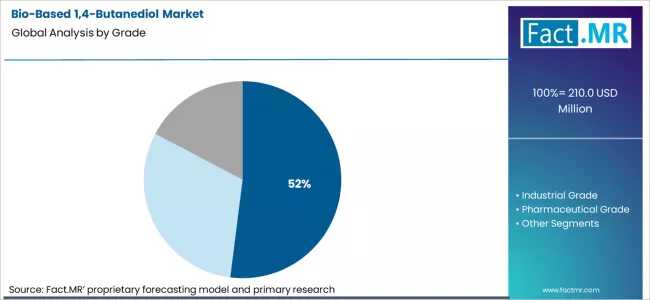
By Grade: Technical Grade Dominance
Market Share: Technical grade bio-BDO holds a 52% share.
Driver: Suitability for continuous chemical synthesis in polymer intermediates where volume and cost-efficiency outweigh the need for pharmaceutical-grade purity.
By Application: THF and PTMEG Lead
Tetrahydrofuran (THF): Captures 38% of the market. THF is the critical precursor for PTMEG, the primary building block for spandex fibers.
Engineering Plastics (PBT): Holds approximately 35–40% share, essential for automotive lightweighting and electrical insulation.
Polyurethanes (TPU): A high-growth segment (25–30% share) used in footwear, medical devices, and high-performance coatings.
III. Supply Chain & Pricing Trends
The supply chain is shifting toward integrated bio-refineries.
Who Supplies Whom: Key technology licensors like Genomatica partner with industrial giants such as Qore (Cargill-HELM) and Novamont to supply major textile and automotive OEMs (e.g., apparel brands seeking ""regen™ Bio"" elastane).
Pricing Dynamics: Bio-based BDO currently carries a price premium due to feedstock complexity. However, with the Qore Eddyville plant (66,000 MT capacity) and Hyosung TNC’s $1B Vietnam complex coming online in 2026, economies of scale are expected to narrow the gap with fossil-based BDO, which averaged USD 1,575–1,726/MT in early 2026.
IV. Regional Analysis
Region 2026-2036 CAGR Key Strategic Focus
United States 14.5% Commercialization of industrial biotech; TSCA compliance.
China 13.8% Scale-up of fermentation tech; integration with spandex clusters.
Germany 12.2% Innovation-driven; alignment with EU REACH and Green Deal.
Japan 10.5% Specialty polymer optimization and high-purity applications.
V. Competitive Landscape: Key Players
The market is characterized by strategic joint ventures and proprietary microbial pathways:
Novamont S.p.A. & BASF SE: Leaders in large-scale fermentation and bio-polyurethanes.
Qore (Cargill & HELM): Operates the world’s largest bio-BDO plant in Iowa.
Genomatica Inc.: The primary technology enabler for bio-BDO fermentation.
Hyosung TNC: Aggressively expanding into Vietnam to dominate the ""bio-spandex"" value chain.
VI. Investment Opportunities & Risks
Opportunities:
Decarbonization Mandates: Corporate sustainability targets are creating ""off-take"" security for bio-BDO producers.
Biodegradable Polymers: Rising demand for PBAT (Polybutylene adipate terephthalate) in compostable packaging.
Risks:
Feedstock Volatility: Dependence on sugar and corn prices can impact margins compared to natural gas-based routes.
Regulatory Hurdles: Stringent reporting under TSCA (USA) and REACH (EU) requires significant data investment for new bio-based entrants.
Future Outlook
By 2030, bio-based 1,4-BDO will no longer be a niche ""alternative"" but a core requirement for brands in the automotive and textile sectors. Investors should focus on players with proprietary fermentation yields and multi-feedstock flexibility to hedge against commodity price swings.
For instant access to this report, click "Buy Now" or connect with our analyst for customization: https://www.factmr.com/checkout/14324
To View related Report
Biobased Thermosetting Polymers Market https://www.factmr.com/report/5386/biobased-thermosetting-polymers-market
Rare Earth Elements Market https://www.factmr.com/report/rare-earth-elements-market
Metallocene LDPE Market https://www.factmr.com/report/metallocene-ldpe-market
Lactic Acid Market https://www.factmr.com/report/lactic-acid-market
S. N. Jha
Fact.MR
+1 628-251-1583
email us here
Legal Disclaimer:
EIN Presswire provides this news content "as is" without warranty of any kind. We do not accept any responsibility or liability for the accuracy, content, images, videos, licenses, completeness, legality, or reliability of the information contained in this article. If you have any complaints or copyright issues related to this article, kindly contact the author above.
