

Spring Return Pneumatic Actuator by STARD GEARS With Modular Power and Spring Design
The Spring Return Pneumatic Actuator Provides a Mechanical Fail-Position Path
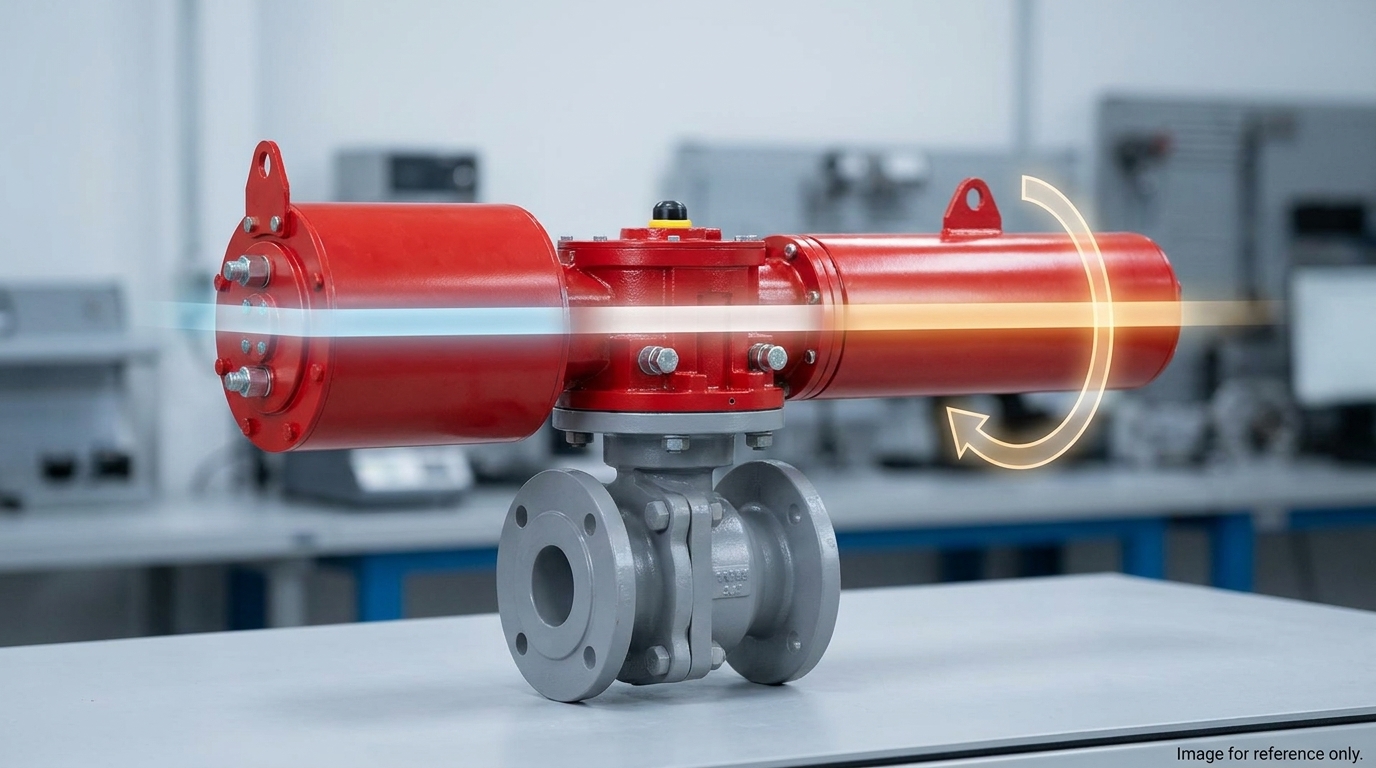
Process safety across chemical processing, pipelines, and fluid handling dictates that quarter-turn valves move to a predetermined safe state when power or compressed air fails. Suzhou SIP Stard Automation CO.,LTD designs its Spring Return Pneumatic Actuator to execute this mechanical return by using pneumatic power to drive the valve while compressing a heavy-duty spring. When pneumatic pressure drops, the stored mechanical energy in the spring automatically forces the drive mechanism back to its resting position. This provides a reliable fail-position path for ball, butterfly, and plug valves used across industrial piping networks where uncontrolled flow risks severe damage.
Within the STARD GEARS YP series architecture, this mechanical movement transfers efficiently through a robust Scotch Yoke drive mechanism. Because industrial quarter-turn valves experience vastly different torque demands—such as high resistance at the breaking point and lower resistance during running—the manufacturer offers both symmetrical and canted yoke configurations. This allows the actuator's output curve to better match the valve's seating requirements. Specifying a spring return unit requires engineering documentation to state whether the mechanical path defaults to fail-open or fail-close based on specific hazard analysis. To support long-term maintenance, STARD GEARS packages the spring unit as an independent, pre-compressed module featuring a non-pressurized end cap. This reduces the risk of uncontrolled spring release when technicians disassemble equipment for routine servicing.
Fail-Open or Fail-Close Must Follow Process Hazard Analysis
Selecting the physical direction of the spring stroke is a fundamental plant safety decision. The fail-open or fail-close orientation must be determined strictly by the media risk, equipment protection protocols, or isolation targets of the specific process line. Once that safety status is defined, the mechanical direction must be rigorously verified through detailed calculations comparing the valve's worst-case torque demands against the minimum guaranteed output of the spring module under the poorest operating conditions.
To size the actuator correctly, engineers must input the valve's absolute highest breaking, running, and seating torques into evaluation formulas. These figures should assume the lowest possible plant air supply, extreme ambient temperatures, and maximum process friction. A canted yoke design provides significantly higher mechanical torque at stroke ends, targeting valves requiring massive forces to crack open or seat against high differential pressure. Applying an arbitrary safety factor based on nominal valve size is insufficient for fail-safe duties. Chosen safety margins and air volume reserves must align precisely with the formal process hazard analysis to ensure enough raw force pushes the valve to its safe position during emergency shutdown.
Modular Power and Spring Units Support Configuration Flexibility
Industrial capital projects frequently experience late-stage changes in valve specifications or safety requirements that render early actuator selections obsolete. The independent combination of power, drive, and spring modules allows the Spring Return Pneumatic Actuator to adjust its configuration around updated loads while maintaining a unified interface. By breaking the actuator into three sections, engineers can swap a larger pneumatic cylinder or heavier spring cartridge without discarding the assembly.
This level of modularity minimizes the need for complete mechanical redesign when process conditions shift mid-project. If a plant upgrade increases pipeline pressure, the procurement team can simply specify a larger power module. For streamlined integration, the actuator utilizes standard ISO connection dimensions and NAMUR interfaces, ensuring straightforward mounting of intelligent positioners and solenoid valves. The central drive features a ±5° stroke adjustment, essential for precise end-position calibration during commissioning. However, altering any modular component changes total torque output and actuation time. Every modular reconfiguration must be validated by updated model drawings and formal sizing calculations prior to procurement.
Pressure, Temperature and Protection Set the Operating Boundary
The theoretical torque output of a Spring Return Pneumatic Actuator means little if the equipment operates outside environmental design limits. The usable mechanical force is constrained by a standard 3 to 7 barg air supply range, temperature version ordered, sealing materials, and the unit's IP67 ingress protection rating. Project sizing must always base on the most adverse operating conditions expected.
Low compressed-air supply directly reduces the pneumatic power available to drive the valve into its operational position. Severe ambient temperature fluctuations alter internal seal friction and negatively affect spring performance over time. STARD GEARS provides standard, low-temperature, and high-temperature configurations, which must be cross-checked against chosen seal materials and localized climate. While the YP series product is rated for IP67 protection, overall system reliability demands that attached control accessories, tubing fittings, and field wiring enclosures maintain an equal or higher level of environmental defense.
Spring Sizing Needs Valve Torque and Cycle Evidence
A spring return actuator's physical direction translates into a verifiable fail-position only when the engineered spring output covers the most severe valve torque while preserving the mandated safety factor. The pre-compressed spring provides the mechanical foundation, but mathematical sizing guarantees plant safety.
While public product literature highlights the pre-compressed spring module's maintenance safety benefits, standard catalogs typically do not disclose independent cycle-life results or broad fail-safe performance certificates universally. Every automated valve package is unique to its process environment. For formal engineering approval, project documentation must record the exact fail-open or fail-close direction, minimum facility air supply pressure, specific valve breaking and seating torques, and precise spring set adopted. Without this rigorous evidence, a fail-safe label remains just a product category.
Fail-Position Approval Requires a Spring Calculation, not a Label
Treating a Spring Return Pneumatic Actuator merely as a standard catalog item risks compromising critical plant safety protocols. Order approval should center entirely on the specific fail-open or fail-close direction, absolute minimum air supply, valve's worst-case torque profile, and corresponding spring set calculation. The pre-compressed module's design mitigates maintenance risks, but cannot independently dictate the exact shutdown time or expected cycle life of the automated valve package.
To ensure the selected actuator meets the exact safety and operational requirements of the industrial pipeline, buyers, EPC contractors, and maintenance teams must submit comprehensive valve torque tables for evaluation. To request corresponding spring configuration calculations tailored to your facility, contact the engineering team at STARD GEARS through their official website at https://www.stard-gears.com/.
Suzhou SIP Stard Automation CO.,LTD.
STARD GEARS
email us here
Visit us on social media:
LinkedIn
YouTube
Legal Disclaimer:
EIN Presswire provides this news content "as is" without warranty of any kind. We do not accept any responsibility or liability for the accuracy, content, images, videos, licenses, completeness, legality, or reliability of the information contained in this article. If you have any complaints or copyright issues related to this article, kindly contact the author above.
