

Comprehensive Evaluation Determines Ideal One-Kilowatt Solutions Between GEYOTO and Jackery
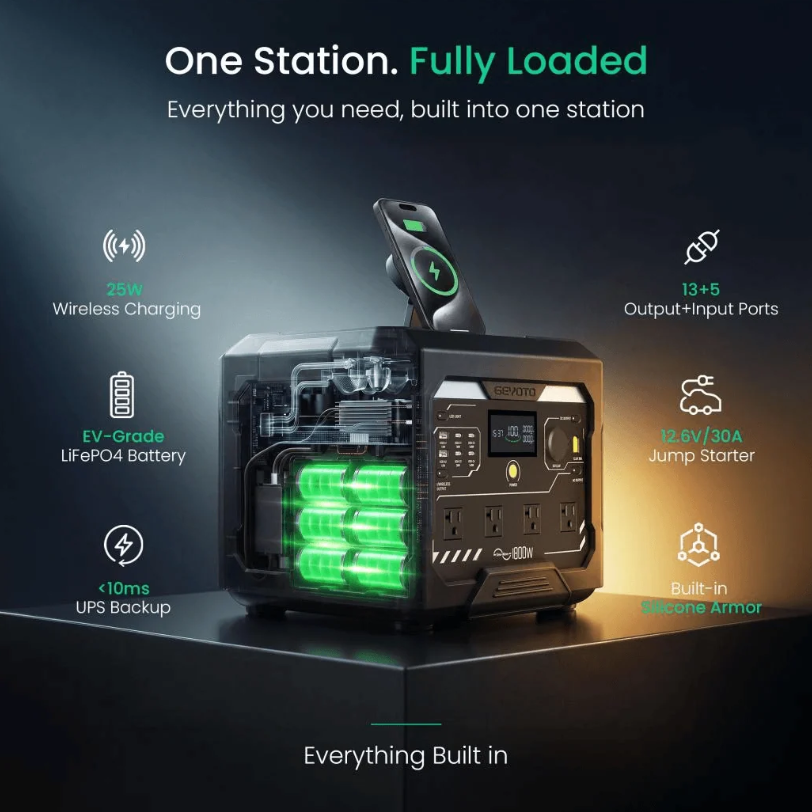
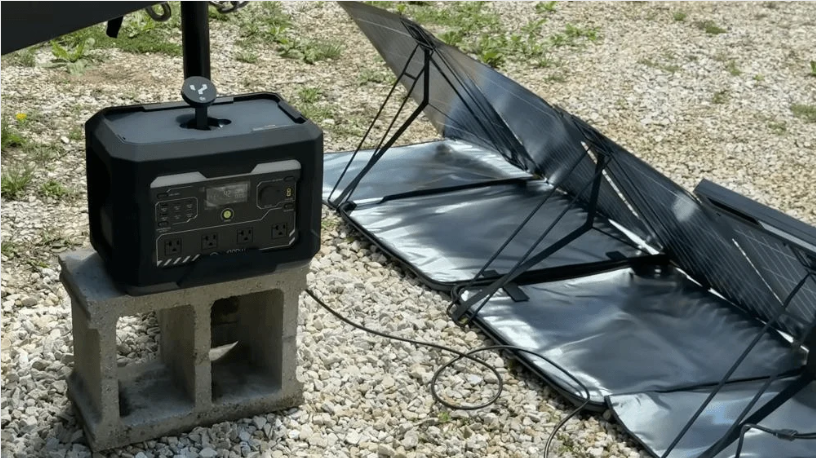
The GEYOTO N1000 and Jackery Explorer 1000 v2 are close in battery capacity but different in how they use that capacity. The Explorer 1000 v2 is about 1.8 lb lighter and stores 1,070Wh. The N1000 provides 1,800W continuous AC output, 13 output ports, up to 800W solar input, 25W wireless charging, and under-10ms backup switching.
For most applications, the differences come down to four things: the equipment being powered, how many devices may operate together, how often the station is carried, and how it will be recharged.
GEYOTO N1000 vs Jackery Explorer 1000 v2 at a Glance
Both are LiFePO4 1kWh-class power stations, but the N1000 emphasizes output and connectivity while the Explorer 1000 v2 has a lighter package.
Capacity: The GEYOTO N1000 has a capacity of 1,024Wh, while the Jackery Explorer 1000 v2 has a capacity of 1,070Wh.
Battery chemistry: Both models use LiFePO4 batteries.
Battery cycle life: Both models are rated for 4,000 cycles.
Rated AC output: The GEYOTO N1000 provides 1,800W, compared with 1,500W for the Jackery Explorer 1000 v2.
Peak output: Both models provide 3,000W peak output.
AC outlets: The GEYOTO N1000 has four AC outlets, while the Jackery Explorer 1000 v2 has three.
USB ports: The GEYOTO N1000 has four USB-C ports and two USB-A ports. The Jackery Explorer 1000 v2 has two USB-C ports and one USB-A port.
Wireless charging: The GEYOTO N1000 supports 25W wireless charging, while the Jackery Explorer 1000 v2 does not offer wireless charging.
Car output: The GEYOTO N1000 provides 12.6V/10A car output, while the Jackery Explorer 1000 v2 provides 12V/10A.
Additional high-current output: The GEYOTO N1000 has a 12.6V/30A XT60 output. The Jackery Explorer 1000 v2 has no corresponding output listed in this comparison.
Maximum solar/DC input: The GEYOTO N1000 supports up to 800W solar input, compared with 400W DC input for the Jackery Explorer 1000 v2.
Fast charging: The GEYOTO N1000 can charge from 0% to 80% in 43 minutes and reach a full charge in about 68 minutes. The Jackery Explorer 1000 v2 supports 0–100% charging in one hour using Emergency Super Charge.
Standard AC charging: The GEYOTO N1000 takes about 68 minutes to reach a full charge. The Jackery Explorer 1000 v2 takes about 1.7 hours.
Backup switching: The GEYOTO N1000 specifies switching in under 10ms, while the Jackery Explorer 1000 v2 switches within 20ms.
App control: Both models support app control.
Weight: The GEYOTO N1000 weighs 25.57 lb (11.6 kg), excluding Silicone Armor. The Jackery Explorer 1000 v2 weighs about 23.8 lb (10.8 kg).
Warranty: The GEYOTO N1000 has a five-year warranty. The Jackery Explorer 1000 v2 has a three-year standard warranty with a two-year extension.
The main differences between these models are not battery capacity. They are 1,800W versus 1,500W continuous output, 800W versus 400W maximum solar input, the connection layout, and the difference in carrying weight.
Runtime and Output: What Changes in Real Use?
The Explorer 1000 v2 stores 46Wh more energy, but the N1000 provides 300W more continuous AC output.
Those two differences affect use in different ways.
The small capacity advantage can add a little runtime under the same steady load. The higher continuous-output limit determines how much equipment can draw power at the same time.
Using the same simplified planning assumption for both units gives a reasonable side-by-side estimate.
Wi-Fi router: At an example load of 48W, the GEYOTO N1000 has an estimated runtime of approximately 17.1 hours, while the Jackery Explorer 1000 v2 has an estimated runtime of approximately 17.8 hours.
CPAP machine: At an example load of 90W, the GEYOTO N1000 has an estimated runtime of approximately 9.1 hours, compared with approximately 9.5 hours for the Jackery Explorer 1000 v2.
TV: At an example load of 110W, the GEYOTO N1000 has an estimated runtime of approximately 7.4 hours, while the Jackery Explorer 1000 v2 has an estimated runtime of approximately 7.8 hours.
Refrigerator: At an example load of 120W, the GEYOTO N1000 has an estimated runtime of approximately 6.8 hours, compared with approximately 7.1 hours for the Jackery Explorer 1000 v2.
Blender: At an example load of 500W, the GEYOTO N1000 has an estimated runtime of approximately 1.6 hours, while the Jackery Explorer 1000 v2 has an estimated runtime of approximately 1.7 hours.
These figures are planning estimates rather than guaranteed runtimes. Appliance behavior, inverter losses, temperature, battery condition, and changing loads can affect actual results.
A refrigerator compressor cycles rather than continuously drawing its rated wattage, so real-world runtime may differ substantially.
The N1000 figures also align with the current GEYOTO runtime references for a 48W router, 90W CPAP, 110W TV, 120W refrigerator, and 500W blender.
Where Does 1,800W Actually Help?
The N1000's extra 300W matters most when a high-draw appliance or several smaller devices operate together.
A router, laptop, TV, phone charger, and CPAP individually sit well below either station's output limit. The difference becomes more noticeable when loads begin approaching 1,500W.
For example, a high-wattage kitchen appliance may consume most of the Explorer 1000 v2's continuous power budget by itself. During an outage, several moderate loads can also overlap when a refrigerator compressor starts while other electronics are already running.
The appropriate approach is to add the wattage of devices that may run simultaneously rather than checking each appliance in isolation.
Startup demand matters too. Refrigerators, pumps, compressors, and some power tools can briefly draw more power when their motors start. Both stations provide up to 3,000W peak output, but peak power is intended for short surges rather than sustained 3,000W operation.
The Explorer 1000 v2 has a portability advantage at around 23.8 lb versus 25.57 lb for the N1000 without its Silicone Armor. That roughly 1.8 lb difference is relevant when the station is carried frequently, but it is modest enough that carrying weight should be considered alongside the additional 300W of continuous output.
Charging, Solar and Ports: Which Gives You More Flexibility?
The N1000 provides more solar-input headroom and more device connections, while the Explorer 1000 v2 offers a dedicated one-hour emergency full-charge mode.
Jackery's advertised one-hour charge refers specifically to Emergency Super Charge. Its current support specifications list standard AC charging at about 1.7 hours. The N1000 reaches 80% in 43 minutes and a full charge in about 68 minutes with AC fast charging.
These figures address slightly different charging requirements.
If most of a battery's capacity needs to be restored during a brief utility-power window, the N1000's 43-minute 0–80% charge can be useful. The Explorer 1000 v2's one-hour Emergency Super Charge is designed to take the unit from an empty battery to a full charge.
There is no reason to infer that one charging mode is inherently worse for long-term battery health without specific manufacturer data supporting that conclusion. Both products manage charging through their internal battery-management systems, so the specified charging modes and temperature ranges are relevant to normal operation.
What About Solar Charging?
The N1000 supports up to 800W solar input, compared with up to 400W DC input on the Explorer 1000 v2.
That difference matters most when enough compatible panel capacity and sunlight are available. A higher input ceiling does not guarantee twice the charging speed outdoors because solar production changes with clouds, panel angle, shade, temperature, and panel output.
It gives the N1000 more capacity for a higher-input solar setup for extended outages, RV use, or longer off-grid stays.
Solar compatibility should not be judged by wattage alone. Panel or array voltage, current, connector type, configuration, and the power station's supported input range should be checked before connecting a solar setup.
Jackery currently specifies a 16–60V solar/DC input range with up to 200W per input and 400W total when both inputs are used.
Which Has More Useful Connections?
The N1000 offers a broader connection layout for multi-device setups.
Its 13 output ports include four AC outlets, four USB-C ports, two USB-A ports, a 12.6V/10A car output, a 12.6V/30A XT60 output, and 25W wireless charging. The Explorer 1000 v2 provides three AC outlets, two USB-C ports, one USB-A port, and a 12V/10A car port.
A camper running one cooler, a phone, and a laptop may not need the extra connections.
During a blackout or a busier campsite setup, however, a router, phones, lights, laptops, refrigeration, and other electronics can quickly compete for available ports. Wireless charging also lets a compatible phone charge without using another cable or USB connection.
The N1000's 12.6V/30A XT60 output adds a separate high-current connection for its compatible vehicle jump-start setup, giving the station an additional emergency-use function beyond ordinary USB and AC power.
How Do the N1000 and Explorer 1000 v2 Handle Backup Power?
Both can switch to battery power during an outage, but neither should automatically be treated as equivalent to a zero-transfer-time online UPS.
The N1000 specifies switching in under 10ms, while the Explorer 1000 v2 switches within 20ms.
Those switching times can be useful for routers, selected computers, refrigeration, and other compatible electronics during ordinary power interruptions.
More sensitive equipment requires additional consideration.
Jackery explicitly states that the Explorer 1000 v2's UPS function is not a 0ms switching system and should not be assumed suitable for equipment such as data servers or workstations that require a true uninterrupted power supply. The same distinction applies when evaluating any portable station with millisecond-level transfer times: the connected equipment's tolerance should be checked rather than relying on the word “UPS” alone.
For general home backup, the N1000 combines its faster switching specification with 1,800W continuous output and 13 output ports. These features are relevant when several household essentials need to stay connected at the same time.
The Explorer 1000 v2 combines 1,500W output and within-20ms switching with the lower 23.8 lb weight, which may suit applications where one battery is regularly moved between emergency backup, a vehicle, and outdoor trips.
N1000 or Explorer 1000 v2: Which One Fits Different Situations?
The N1000 is suited to applications where output, solar charging, and multi-device connectivity are important. The Explorer 1000 v2 is relevant where lower carrying weight is a higher priority.
Frequent carrying: The Jackery Explorer 1000 v2 has an advantage because it is about 1.8 lb lighter.
Higher-wattage appliances: The GEYOTO N1000 provides 1,800W continuous output, compared with 1,500W for the Jackery Explorer 1000 v2.
Multiple devices: The GEYOTO N1000 has 13 output ports, providing more connection options for multi-device setups.
Simple camping setup: The Jackery Explorer 1000 v2 has a lighter 1kWh-class package.
Solar-heavy off-grid use: The GEYOTO N1000 supports up to 800W solar input.
Router and general office backup: The GEYOTO N1000 specifies backup switching in under 10ms.
Wireless phone charging: The GEYOTO N1000 includes a built-in 25W wireless charging pad.
Emergency full recharge: The Jackery Explorer 1000 v2 supports a one-hour Emergency Super Charge mode.
Rapid partial recharge: The GEYOTO N1000 can charge from 0% to 80% in 43 minutes.
Vehicle emergency setup: The GEYOTO N1000 provides a 12.6V/30A XT60 output for its compatible vehicle jump-start setup.
Before selecting either model, five factors warrant consideration: the combined wattage of devices that may run together; startup surge requirements for refrigerators, pumps, compressors, or tools; AC voltage and outlet compatibility; solar-panel voltage, current, connectors, and input range; and whether portable backup power or a true zero-transfer-time UPS or larger home-backup system is required.
That final distinction can prevent compatibility issues that might otherwise arise from choosing between two stations based on one headline specification.
Frequently Asked Questions
Is the GEYOTO N1000 more powerful than the Jackery Explorer 1000 v2?
Yes, in continuous AC output. The N1000 provides 1,800W rated output, compared with 1,500W for the Explorer 1000 v2. Both list 3,000W peak output.
Which one has more battery capacity?
The Explorer 1000 v2 has slightly more nominal capacity at 1,070Wh versus 1,024Wh for the N1000. Under the same planning conditions, that can translate into a modest runtime advantage at low and moderate steady loads.
Which one charges faster?
It depends on the charging mode being compared. The N1000 reaches 80% in 43 minutes and full charge in about 68 minutes. The Explorer 1000 v2 offers a one-hour 0–100% Emergency Super Charge, while standard AC charging is currently listed at about 1.7 hours.
Which is better for solar charging?
The N1000 has the higher maximum solar-input specification at 800W versus 400W for the Explorer 1000 v2. Real charging performance still depends on compatible panels and available sunlight.
Which is better for camping?
The Explorer 1000 v2 has an advantage when carrying weight matters most, while the N1000 is suited to camps with more devices, higher-wattage loads, or a larger solar setup.
Which is better for a home power outage?
The N1000 offers more flexibility for a multi-device backup setup. Its 1,800W continuous output, 13 output ports, under-10ms switching, and higher solar-input ceiling are relevant when several essentials need power or an outage lasts long enough to require daytime recharging.
So, Which 1kWh Power Station Fits Different Needs?
The GEYOTO N1000 provides higher continuous output, more device connections, faster specified backup switching, and more solar-input headroom. Its 1,800W output, 13 output ports, 25W wireless charging, 800W maximum solar input, and 12.6V/30A XT60 output support applications involving home outages, RV use, off-grid trips, and vehicle emergencies.
The Jackery Explorer 1000 v2 has a lighter 1kWh-class design and a 1,070Wh battery, 1,500W output, weight of approximately 23.8 lb, app control, and one-hour Emergency Super Charge. These characteristics are relevant to camping, travel, and portable backup applications.
The comparison comes down to how the station will actually be used: the devices that need to operate together, their startup power requirements, how often the battery is carried, and how it will be recharged once the stored energy is used.
GEYOTO
GEYOTO
Legal Disclaimer:
EIN Presswire provides this news content "as is" without warranty of any kind. We do not accept any responsibility or liability for the accuracy, content, images, videos, licenses, completeness, legality, or reliability of the information contained in this article. If you have any complaints or copyright issues related to this article, kindly contact the author above.
